Raising exit questionnaire completion rates: what works.
When few leavers complete an exit questionnaire, the usual explanation is that people stop caring once they have resigned. In our experience the cause is nearly always the process.
On this page
Ten practical levers, most of which cost nothing but attention.
Free download: Exit process checklist ↓A low completion rate is more than a smaller dataset. The leavers who answer may not be like the ones who do not, and you cannot tell in which direction the difference runs. A report built on a third of leavers can look precise and still mislead. The encouraging part is that completion responds to practical changes in who asks, when, how often, and whether people are invited at all.
First, measure the right thing
Two figures are often confused. The invitation rate is the share of leavers who were invited at all. The response rate is the share of those invited who completed. Multiply them and you have the figure that matters: the completion rate, completed questionnaires as a share of everyone who left in the period.
| Measure | Calculation | Result |
|---|---|---|
| Leavers in the year | From the HR system | 120 |
| Invited | 90 of 120 | 75% invitation rate |
| Completed | 54 of 90 invited | 60% response rate |
| Completion rate | 54 of 120 leavers | 45% |
Illustrative. On a provider’s dashboard this organisation has a 60% response rate. A quarter of its leavers were never asked, and that is the first thing to fix.
Ten levers that raise completion
Invite every leaver
Reconcile the leavers on your HR or payroll system against the people invited, every month. Gaps open in predictable places: resignations processed late, fixed-term contracts that simply end, teams with no local HR support. The lasting fix is to make the invitation part of the resignation process, so that accepting a resignation triggers the invitation the same day. Decide, and write down, which leavers are in scope. Some organisations leave out dismissals, for example; that should be a choice, not an accident.
Invite early
Invite at least three weeks before the last day, where the notice period allows. People working their notice are reachable on their work email, remember the detail and often have time. Invitations sent in the final days compete with handovers; invitations sent after the leaving date go to an inbox nobody reads. If notice is short, invite on the day the resignation is accepted, and ask for a personal email address in case.
Find a senior champion
Completion follows visible importance. Ask a senior leader or the HR director to own the process: to know what it is for, to put their name to the invitation, and to mention it when the subject comes up. They do not need to do much. They need to be seen to care.
Make the invitation personal
An invitation that looks automated gets treated as automated. Send it from a named person, ideally the champion, rather than a no-reply address, and say four things plainly: why the organisation wants to hear from them, how long it takes, who will see their answers, and the date to complete it by.
Illustrative wording“Before you go, I’d value ten minutes of your time. Your answers go to [independent provider], not to your manager, and we only ever see results for groups of five or more. Last year, leavers told us [issue]; we changed [change].”
Remind, and change the words
Remind people who have not yet completed, once a week, on the same day each week; that has long been our own practice. Do not repeat the invitation word for word. A reminder that says something new – the deadline, one thing earlier leavers changed – is more likely to be read. Stop as soon as someone has completed.
Brief the people around the leaver
A line manager can help with one sentence in a final one-to-one: “You’ll get an invitation to an exit questionnaire. It goes to an independent provider, and it would help if you did it.” Local HR can check that leavers have the time and access to complete it. Both need to know what the process is for and what is asked of them. Neither should ask whether someone has completed it, or what they said.
Make it easy
Short (fifteen minutes at most), on any device, with no login. Provide a sign-up page or QR code for people without a work email address. For people on shifts or away from a desk, the simplest lever of all is time: a slot and a quiet place to do it during the working day in their final week.
Give something back
Tell leavers what earlier leavers changed: one concrete example in the invitation does more than a paragraph about how much their views matter. Some organisations add an incentive, such as a donation to charity for every questionnaire completed. We suggest a charity donation rather than a personal reward, so that nobody feels paid for an answer.
Make completion someone’s job
Publish completion figures monthly, by area or by the administrator responsible, to the people who can change them. It does not need to be a league table; it needs to be seen. In our experience, completion improves when someone’s name sits next to the figure.
Ask the people who are leaving
If completion stays low, ask. A short conversation with a few people who have resigned and are still working their notice – what would make them complete it, what would put them off – tells you more than another reminder.
A monthly routine
Pull the month’s leavers from the HR system. Check each one was invited, and invite anyone missed. Look at completion by area and pass the areas with the lowest figures to local HR. Report three numbers: invitation rate, response rate and completion rate. Put the completion rate on the front page of every leaver report, so that everyone reading the results knows how much weight they can bear.
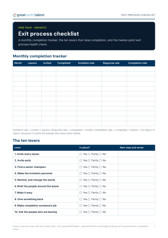
Exit process checklist
A monthly completion tracker, the ten levers as a checklist with owners, and the twelve-point exit process health check on paper.
Four things that lower completion, or candour
- Making it compulsory, or linking it to final pay, a reference or returning equipment. You will get completions, not honest answers.
- Handing it out through the line manager, who is often part of the reason someone is leaving and always part of the reference.
- Promising anonymity you cannot keep; see Anonymity and confidentiality in employee surveys.
- Sending it after the leaving date to a work address that has already closed.
To see how the whole process stands up – independence, timing, anonymity, reporting and action as well as completion – try the exit process health check. For what to do with the results once they arrive, see How to read a leaver analysis report, and for the wider design choices, How to choose an exit interview approach.
Drawn from great{with}talent’s factsheet Tips for raising leaver completion rates (2013), rewritten and extended for any organisation running its own exit questionnaire. The figures in the table are illustrative. LastOpinion runs independent exit questionnaires with automatic reminders.
See what your own data already knows.
Send us your last twelve months of leaver data and we’ll show you what it reveals – no charge, no deck, no obligation. Or start with a free trial or a 30-minute conversation.