Building a returner programme in an NHS trust.
Half of the NHS staff who leave dissatisfied say they would consider coming back. A returner programme is how a trust turns that goodwill into people on the rota.
On this page
Seven steps, from asking the would-return question at exit to measuring how many returners are still in post a year on.
Free download: NHS returner programme: checklist and tracker ↓Why it is worth doing
A returner already knows your systems, your patients and often your teams. They need less induction than a stranger and are a known quantity. Our NHS exit data, December 2024 – December 2025, found that 56% of leavers left on their own terms and are a natural pool of returners and ambassadors, and that half of the 44% who left dissatisfied would still consider coming back. Across organisations, the share of leavers who would consider returning ranges from 57% to 83%. Report 1 of the series recommends a returner-friendly alumni strategy: bank and temporary roles for retirees, return-to-practice support, alumni networks and targeted re-recruitment. The steps below are how to put that in place.
Ask the question on the way out
You cannot invite back people you have not asked. Make sure your exit questionnaire asks every leaver whether they would consider returning, and asks separately for consent to be contacted about future roles – and how. Record the reasons they left alongside, because for anyone who left unhappy those reasons are the conditions for their return. In our experience, people answer more candidly when the questionnaire is independent of their line manager; How to choose an exit interview approach explains why.
End well
In our experience, the last few weeks shape how people remember you. Make sure every leaver hears a thank-you from their manager, is told plainly that the door is open, and knows how to join the bank. For staff approaching retirement, offer a conversation well before their date about the options: retire and return, partial retirement, bank work or a smaller role.
Keep in touch, lightly
Give one person ownership of the alumni list. Contact only people who have consented, and give an easy way to opt out in every message. We suggest a small number of fixed contact points – around three, six and twelve months after leaving – rather than a newsletter nobody reads. Lead with what has changed, then with relevant vacancies.
Fix what drove them out, and say so
Report 1 found that many unhappy leavers are willing to come back if conditions improve. So the most persuasive returner message is evidence. Review leaver reasons by staff group, choose one or two actions per group, and when something changes, tell former staff in the terms they used when they left: “Several of you told us there was no route to a band 6 post without moving trust. Since April we have published our development pathway and ring-fenced six posts for internal applicants.” (Illustrative.)
Make the routes back easy
Offer more than one way back and make each simple:
- Bank and temporary roles, including for retirees who want some clinical or professional work on their own terms.
- Retire and return and partial retirement. Since 1 April 2023 the NHS Pension Scheme’s 16-hour rule no longer applies and retired 1995 Section members who return can join the 2015 Scheme. Partial retirement lets members aged 55 or over, with their employer’s agreement, draw 20% to 100% of their pension while carrying on working, provided pensionable pay falls by at least 10% for at least 12 months. Conditions apply, so point staff to NHS Pensions for their own position.
- Return to practice for nurses, midwives and nursing associates whose registration has lapsed and who cannot meet the NMC’s practice-hours requirement: the routes back are an NMC-approved return to practice programme or a test of competence. Supporting returners through one is a direct way to bring experienced staff back.
- Flexible working from day one. Staff on NHS terms and conditions (Agenda for Change) have had a contractual right to request flexible working from their first day since September 2021, and a statutory day-one right to request has applied to all employees since 6 April 2024. For many returners, especially carers, the pattern of hours is the deciding factor.
Then remove friction: a named contact, a short application route, and pre-employment checks re-run promptly – the NHS Employment Check Standards still apply.
Re-onboard returners properly
Returners are new starters too, and the same early risks apply. Have systems access, rota and equipment ready on day one, brief them on what has changed, and give them the same week-one, 30-day and 60-day check-ins as anyone else. A returner who finds that nothing has changed has every reason to leave again.
Measure it
We suggest four measures: the would-return rate by staff group and by happy and unhappy leaver; returners per quarter; time from first contact to start date; and the share of returners still in post after twelve months. Report them alongside turnover, not in a separate paper.
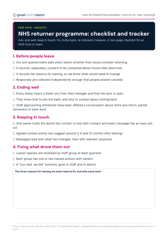
NHS returner programme: checklist and tracker
Two A4 pages: a tick-box checklist for each stage, the routes back and the friction to remove, and a returner tracker.
Pitfalls to avoid
- Treating it as a campaign. A one-off “come back to us” drive produces a spike and then nothing; the steps above are a process that runs all year.
- Ignoring consent. Contacting people who have not agreed to it, or keeping their details longer than your privacy notice allows.
- Only chasing the happy leavers. They are the easiest conversation, but the reluctant leavers are where the evidence of change matters most and where the data says the door is open.
- Promising change that has not happened. If the reason someone left is still there, say what you are doing about it and when – and do not invite them back to the same problem.
- Forgetting the trust down the road. In our 2020 NHS benchmark, 72% of leavers moving jobs went to another NHS organisation and almost half described the move as a step up. If your progression routes are not visible, your returners are someone else’s new starters.
The evidence behind this guide is in Would they come back? The returner opportunity in NHS exit data.
Drawn from great{with}talent, Why NHS Staff Leave, NHS Workforce Intelligence Series Report 1 of 4 (December 2024 – December 2025), with the re-onboarding cadence from Report 2, and the great{with}talent LastOpinion NHS leaver benchmark (June 2020; an aggregated report compiled for participating trusts). Pension, registration and flexible-working points checked on 16 October 2026 against NHS England, NHS Business Services Authority, Nursing and Midwifery Council and NHS Employers guidance; they are a summary, not pension or legal advice. LastOpinion asks every leaver the would-return question as standard.
See what your own data already knows.
Send us your last twelve months of leaver data and we’ll show you what it reveals – no charge, no deck, no obligation. Or start with a free trial or a 30-minute conversation.