What NHS line managers can do in a new starter’s first 12 weeks.
Whether an NHS new starter settles is decided less by the induction programme than by what their line manager does in the weeks that follow.
On this page
A five-stage plan around the week-one, 30-day and 60-day conversations that a busy ward or clinic manager can keep to.
Free download: A new starter’s first 12 weeks: manager plan ↓What the data says managers control
New starters in the NHS arrive motivated and mostly well recruited. Our NHS new-starter data, December 2024 – December 2025, found that the gap between those who settle and those at risk is not motivation or capability. It is clarity and reinforcement, and regular feedback from the line manager is the clearest example: it accounts for eight of the ten largest gaps between staff groups, and disabled starters are 5.5 percentage points less likely to receive it. Only 65% have an agreed development plan, though learning and development was the main reason people chose the trust. The full findings are in The first 90 days in the NHS.
Report 2 recommends a simple rhythm: a week-one check-in, a 30-day conversation about how performance is measured, and a 60-day development discussion. The plan below builds that into twelve weeks. The timings outside those three conversations are our suggestions; adapt them to your rota.
Before day one
Keep in touch between offer and start – 17% of new starters had a poor experience of being kept informed about timing during recruitment, and silence after the offer feels the same. Request systems access, logins and equipment early, set the first rota, and name a buddy. If adjustments have been agreed, check they are in place before the person arrives rather than on the day.
Week one: the essentials and a first check-in
Welcome them in person and introduce the team and the buddy. Walk through the day-one essentials yourself or make sure someone does: logins and systems, the phone system, how to order what they need, how to claim expenses, and where to go for help. The first four are where our NHS data found most dissatisfaction in the first weeks; expenses was the worst, with a third of new starters dissatisfied. End the week with a fifteen-minute check-in. Ask: “What has been easy?”, “What has got in your way?” and “What do you still not have that you need?” Fix what you can that day.
Weeks two to four: what good looks like
Keep a short weekly check-in. Around day 30, hold the first real conversation about performance. Ask them first: “What do you think good looks like in this role?” Then fill the gaps with specifics – the standards, the measures, what a good shift or week looks like, and what you will give feedback on. Ask which part of the job feels least clear. Nearly a quarter of NHS new starters do not clearly understand how their performance is measured; this conversation is where that changes.
Weeks five to eight: feedback and a development plan
Give feedback at a predictable rhythm, not only when something goes wrong; in our experience, new starters often read silence as a bad sign. Around day 60, agree a written development plan. Start with what they hoped to learn when they applied – learning and development was the most common reason NHS starters gave for joining. Ask what they would like to be doing in a year, and agree what will happen in the next three months: training, shadowing, a project, a preceptorship or competency milestone where one applies.
Weeks nine to twelve: the 12-week review
We suggest a review at around twelve weeks, before uncertainty hardens into a decision. Ask how closely the job matches what they expected, how confident they feel, how long they see themselves staying, and what would make the most difference. Around one in five NHS starters describe only an “okay fit” with their role, and about a third do not know how long they will stay; this is the conversation that can move them. Agree the regular one-to-one rhythm from here.
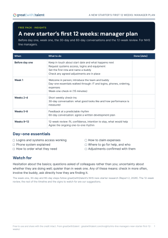
A new starter’s first 12 weeks: manager plan
Two A4 pages: the 12-week timeline with tick boxes, a day-one essentials checklist, signs to watch for, and note boxes with questions for each conversation.
Who needs more support
In our experience the signs are: hesitation over the basics after the first fortnight; questions going to colleagues rather than to you; uncertainty about whether they are doing well; noticeably quieter than in week one. Report 2 recommends targeted support where risk is higher – a buddy, more frequent check-ins and an early conversation about well-being. In the data, the highest at-risk rates were among the ‘Nursing and Midwifery Qualified’ and additional professional, scientific and technical groups, and among disabled starters, so be especially deliberate with them.
For disabled starters, make adjustments hold. Our NHS leaver data found disabled staff describing adjustments that were agreed but not consistently applied, or that unravelled when a manager changed. For a new starter, confirm adjustments before day one, check at each conversation that they are working, and record them so they survive a change of manager or rota.
Common pitfalls
- Leaving it to induction. Induction is rated well in the NHS; the gaps are in what happens locally afterwards.
- Cancelling the check-in when the shift is busy. Move it, do not drop it – ten minutes kept is worth more than thirty planned.
- A development plan that is a form. If nothing in it happens within three months, it has not done its job.
- Assuming no news is good news. At-risk starters are not disengaged; they are uncertain, and uncertainty is quiet.
For the data behind this plan, see The first 90 days in the NHS and The early-leaver window in the NHS. For the development conversation itself, Career and development conversations has a four-step method.
Drawn from great{with}talent, Understanding the New Starter Experience in NHS Trusts, NHS Workforce Intelligence Series Report 2 of 4 (new-starter questionnaires collected through OnBoarder, December 2024 – December 2025), with the finding on adjustments from Report 4, Leaving Through an EDI Lens. The week-one, 30-day and 60-day conversations are the report’s recommendations; the rest of the timeline is great{with}talent guidance. Our rolling new-starter benchmark (each trust’s latest twelve months, five NHS trusts) uses a different period and mix of trusts, so its NHS figures differ.
See what your own data already knows.
Send us your onboarding or new-starter data and we’ll show you what it reveals – no charge, no deck, no obligation. Or start with a free trial or a 30-minute conversation.