The duty to prevent sexual harassment: the evidence a policy can’t give you.
From 30 October 2026 employers must take all reasonable steps to prevent sexual harassment of staff, and answer for harassment by customers and clients. The question is what you did, and whether it worked.
On this page
Eight kinds of evidence that show your steps are working, not just written down.
Free download: Reasonable steps evidence file ↓What the law requires, and from when
- 26 October 2024: the preventative duty. Under the Worker Protection (Amendment of Equality Act 2010) Act 2023, employers must take reasonable steps to prevent sexual harassment of their employees in the course of their employment. There is no standalone claim for breach, but where a tribunal upholds a sexual harassment claim and finds the duty was breached, it can increase compensation by up to 25%. The Equality and Human Rights Commission (EHRC) can investigate and take enforcement action; an investigation does not need an incident to have occurred.
- 6 April 2026: whistleblowing. Disclosures about sexual harassment can now qualify for whistleblowing protection in their own right (Employment Rights Act 2025, s.23), subject to the usual tests.
- 30 October 2026: all reasonable steps. From this date the duty is to take all reasonable steps. Taking some sensible steps while leaving out others that were reasonable is not enough.
- 30 October 2026: third-party harassment. Employers must not permit a third party – a customer, client, contractor or member of the public – to harass their employees in the course of their employment, and are liable unless they took all reasonable steps to prevent it. This covers sexual harassment and harassment related to protected characteristics other than pregnancy and maternity, and marriage and civil partnership.
- Not yet set: regulations on reasonable steps. The Act lets the government specify steps that count as reasonable, which may include assessments, published plans or policies, reporting arrangements and complaint handling. As at October 2026 none had been made, and commentators did not expect them before 2027.
The 2026 changes apply in England, Wales and Scotland; equality law is devolved in Northern Ireland. Sections 20 to 22 of the Employment Rights Act 2025 were brought into force for 30 October 2026 by S.I. 2026/1065. great{with}talent is a workforce intelligence business, not a law firm: this is a map, not legal advice. Take advice on your own obligations, and check dates against GOV.UK and the EHRC before relying on them.
What “all reasonable steps” will be judged on
There is no checklist in the Act, and the EHRC is clear that the examples in its guidance are illustrative, not a complete list. But its technical guidance (last updated in September 2024, and being revised for the 2026 changes as at October 2026) points in one direction. It says an employer is unlikely to comply without carrying out a risk assessment. Its examples include anonymous reporting routes, refreshed staff surveys to test whether measures are working, training with refreshers, and a log of incidents reviewed for trends. The EHRC also publishes an eight-step guide for employers.
Read that list as a tribunal would. Most of it is not a document but a record: a risk assessment that was carried out and acted on, a reporting route that people used, a survey that was run and repeated, a log that someone reviewed. “All reasonable steps” is a standard of evidence.
Policy, and the evidence behind it
| Step | What the policy says | The evidence that shows it worked |
|---|---|---|
| Risk assessment | “We assess the risk of sexual harassment.” | A dated assessment of where, when and from whom the risk arises – customers and other third parties included – informed by what staff say, with actions and owners. |
| Staff experience | “We consult staff.” | An anonymous survey asking whether people have experienced or witnessed harassment, from whom, and whether they reported it; if not, why not. Broken down by team and site above a minimum group size, and repeated so you can show a trend. |
| Reporting routes | “Staff can report concerns, named or anonymously.” | Evidence that the routes are known and trusted: survey answers on whether people know how to report and would feel safe doing so, alongside the number and sources of reports over time. |
| Complaint handling | “Complaints are investigated promptly.” | A log showing time to resolve, outcomes, whether the person who raised it heard back, and whether they experienced any detriment afterwards. |
| Training | “All staff are trained.” | Completion records, plus a check that understanding and confidence to report actually changed – for example, the relevant survey items before and after. |
| Third parties | “We tell customers our standards.” | Reports from customer-facing staff, contract terms and visible notices, and a record of what happened when a customer crossed the line. |
| Leavers | Often silent | Exit questions on harassment and conduct, so that people who never raised a concern still leave a record. |
| Review | “We review the policy annually.” | A board or committee report on the evidence above, what changed as a result, and the date of the next review. |
Why a quiet complaints log is not enough
A low number of complaints is a tempting figure to point to, and a weak one. It can mean people are safe. It can equally mean they do not know how to report, do not believe anything will happen, or fear what will happen to them if they do. In a complaints log the two readings look identical; in an anonymous survey they look very different. There is more on this in Silence isn’t evidence.
Third-party harassment needs its own evidence
Liability for third-party harassment changes where the risk sits. For anyone whose staff deal with the public – shops, hospitality, health and care, transport, education, contact centres, events – the people most at risk may never meet the people who wrote the policy. Ask customer-facing staff directly and separately: have they been harassed by customers or other third parties, how often, where and when, and did reporting it make any difference? Then make sure the risk assessment reflects what they said.
Four things worth doing now
Gather what you hold
The risk assessment, the policy, training records, the complaints log, any survey or exit data on harassment: list them, and note the gaps.
Cover third parties in the risk assessment
Check it role by role and setting by setting.
Fill the gap on staff experience
If you have no recent, independent evidence of what staff experience, plan an anonymous survey, and set the reporting minimum before launch (see Anonymity and confidentiality in employee surveys).
Decide who reviews the evidence
Agree how often, and where that review is recorded.
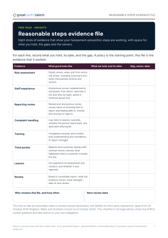
Reasonable steps evidence file
Eight kinds of evidence on one page, with what good looks like and space for what you hold, the gaps, owners and dates.
Sources: Equality Act 2010 s.40A (inserted by the Worker Protection (Amendment of Equality Act 2010) Act 2023, in force 26 October 2024); Employment Rights Act 2025 ss.20–22 (legislation.gov.uk), commenced for 30 October 2026 by S.I. 2026/1065, made 1 October 2026; business.gov.uk, Workplace sexual harassment and third-party harassment (updated 17 September 2026); EHRC, Sexual harassment and harassment at work: technical guidance (updated 26 September 2024; revision in progress); law-firm commentary (September 2026). All checked 16 October 2026. Dates move: re-check before relying on them. This page is not legal advice. great{with}talent’s SafeSpace provides an independent harassment audit and an always-on reporting route; see also The Employment Rights Act 2025: what to measure, and when.
The clearest thirty minutes in your week.
Book a walk-through with a real person, or start with a pilot or a 30-minute conversation.