Exit interview questions that get honest answers.
Most exit interviews produce the same polite answers: a better opportunity, more money, time for a change. The questions are part of the reason.
On this page
Have someone independent ask, at least three weeks before the last day. Use the 25 questions below, record every area the same way for every leaver, and report what unhappy leavers say, by team and over time.
Free download: Exit interview question sheet ↓Before the questions: who asks, and when
- Who asks. The line manager is the person least likely to hear the real reason, because they are often part of it and always part of the reference. HR does better; an independent party does best, with a clear promise about confidentiality – exactly who sees what – and how results are reported.
- When. During the notice period, at least three weeks before the last day where notice allows, while people are still engaged and remember the detail. Not on the last afternoon, between the leaving drinks and handing in the laptop.
- Questionnaire or conversation? A questionnaire gives you consistency, candour and numbers you can compare across teams and years. A conversation gives you depth. The strongest approach uses both: a questionnaire for every leaver, and a follow-up conversation with selected ones – key people, unhappy leavers, and anyone from a part of the organisation where turnover is a concern. How to choose an exit interview approach covers that decision in detail.
The questions, grouped by purpose
Here are 25 questions that get past the polite version, in nine groups. Use the groups as a frame and pick within them. In a conversation, follow the person’s answers rather than reading down the list, and keep coming back to the question that matters most: what was the single biggest factor, and why?
| Group | What it is for | Questions |
|---|---|---|
| Setting the scene | Context and timing |
|
| The decision | The headline reason, in their terms |
|
| The work itself | Job satisfaction, use of skills, autonomy |
|
| Manager and team | The relationships |
|
| Growth and progression | Development and fairness of advancement |
|
| Reward and workload | Pay, recognition, well-being |
|
| The organisation | Confidence, trust, fairness, values |
|
| What would have changed it | The retention lesson |
|
| Looking ahead | Advocacy and the door back |
|
Questions to avoid
- “Why are you really leaving?” It implies they have not been honest so far, and invites the safest answer.
- Leading questions. “It was the workload, wasn’t it?” gets agreement, not information.
- Double-barrelled questions. “How did you find your manager and team?” gets an answer to whichever half is easier.
- Closed questions about what you could have done. “Is there anything we could have done?” gets “not really”; ask “what one change would have made you stay?” instead.
- Demands for the new employer and salary. Ask, and accept a no.
- Counter-offers dressed as questions. If you want to make an offer, make it separately and openly.
- Questions about protected characteristics. Keep them out of the interview itself: collect demographic information separately, voluntarily, for analysis only.
One more: if a leaver describes bullying, harassment or other misconduct, do not just file it in the exit data. Explain how they can raise it formally, and make sure it reaches the right process.
One habit that makes the answers comparable
For every area a leaver talks about – the manager, progression, workload, pay and so on – record whether it was a reason for leaving, a contributing factor, or a strength. Three categories (plus “not applicable”), every leaver, every time. It turns a pile of conversations into data you can count, and it captures what people valued as well as what pushed them out. Strengths are what you protect; reasons are what you fix.
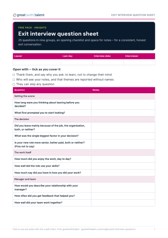
Exit interview question sheet
All 25 questions with space for notes, an opening checklist and a reminder to classify each area the same way for every leaver.
How to report the themes
- Split happy from unhappy leavers. Define an unhappy leaver as someone who says dissatisfaction with the job, the organisation or both was a factor in leaving. Someone who was satisfied with both but is leaving to retire, relocate or study is a different story. The unhappy group is the turnover you can most influence, and the board figure that matters is how large it is and whether it is shrinking.
- Count reasons the same way every time. Use the reason / contributing / strength classification, and rank the reasons for the unhappy group.
- Break it down. Report by team, manager, site, role, length of service and demographic group; groups of fewer than five are typically not reported. Whether the problem is a department, a manager or a stage of tenure (for instance, people leaving in their first year) changes the fix completely.
- Put the “what would have kept you” answers next to the reasons. They are usually specific and cheap: a conversation about career plans, clearer promotion criteria, a manager who gave feedback. See what leavers across sectors say in What would have kept them? and the wider picture in why people leave UK organisations.
- Track would-recommend and would-return. They tell you about your employer brand and about a pool of people who might come back.
- Use own words carefully. Quotes bring a report to life; anonymise them and leave out anything that identifies the person.
- Close the loop. Report quarterly, show the trend, and say what has changed as a result. Then ask the same questions of people who are staying – stay interviews – and compare the two lists.
Drawn from the question set and follow-up interview guide behind great{with}talent’s LastOpinion exit questionnaires, used by organisations across sectors since 2003, rewritten here for anyone running their own exit interviews.
See what your own data already knows.
Send us your last twelve months of leaver data and we’ll show you what it reveals – no charge, no deck, no obligation. Or start with a free trial or a 30-minute conversation.