Stay interviews: ask people why they stay, before they tell you why they left.
An exit interview tells you why someone went, when it is too late to change their mind. A stay interview asks the same questions of the people you still have.
On this page
Who to talk to and when, twelve questions in three groups, and a stay plan you follow up within two weeks.
Free download: Stay interview question sheet ↓What a stay interview is, and is not
A stay interview is a short, structured one-to-one in which a manager asks someone what keeps them in the organisation, what might take them away, and what could change. It is not an appraisal, a pay review or an engagement survey. It is a single conversation with a single person, held because you want to keep them, and it ends with something agreed. It takes thirty to forty-five minutes and costs nothing.
The case for it is simple. When people leave, the reasons they give – no progression, a poor relationship with their manager, workload, not feeling recognised – were often there long before the resignation. Asking early gives you the chance to act on the ones you can change, and to be honest about the ones you cannot.
Decide who, and when
Start with the people you would most hate to lose: key skills, hard-to-replace roles, strong performers, and anyone in a part of the organisation where turnover already worries you. Then add people at the moments when leaving is most likely: towards the end of their first year; after a missed promotion or a rejected application; after a change of manager, team or role; on return from long leave; and after a restructure. Over time, aim to offer it to everyone once a year. Be open about how people are chosen; a conversation offered only to favourites breeds resentment.
Decide who asks
Usually the line manager, because much of what people want changed – workload, recognition, development, how they are managed – is in the manager’s gift. The exception is when the relationship with the manager is itself the issue; then a skip-level manager or HR partner is better. Brief managers first: the purpose, the questions, and what they can and cannot offer.
Set it up properly
Book thirty to forty-five minutes, separate from any appraisal or regular one-to-one. Tell the person in advance what it is for, so they are not alarmed by the invitation: “I want to understand what keeps you here and what might not, so I can do more of the first and less of the second.” Choose a private, unhurried setting.
Ask, listen and take notes
Use a handful of the questions below, not all of them. Your job is to listen: do not explain, defend or fix in the moment. If you hear something uncomfortable, thank them for saying it. Write down what they say in their words.
Agree a stay plan, and follow up
Close by summarising what you heard and agreeing one or two specific things, each with an owner and a date. Say clearly what you cannot change and why; honesty about limits builds more trust than vague promises. Diary a follow-up within two weeks and keep it.
Twelve questions that work
Choose five or six. Start with what keeps them, because it is easier to answer and tells you what to protect.
What keeps you here
- What do you look forward to when you come to work?
- What would you like to learn next?
- When you tell friends about your job, what do you say?
What might take you away
- What last made you think about leaving?
- If another organisation approached you tomorrow, what would tempt you?
- What gets in the way of doing your best work?
- How manageable is your workload?
What we can change
- Do you feel recognised for what you do here?
- What could I do more of, or less of, as your manager?
- Can you see a route here to where you want to be in two years?
- If you ran the team for a week, what would you change first?
- What is one thing we could do that would make you more likely to stay?
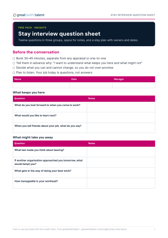
Stay interview question sheet
The twelve questions with space for notes, a pre-conversation checklist and a stay plan with owners, dates and a follow-up.
An optional exercise: sort what matters
Some people find it hard to say what keeps them. A simple card sort helps. Give them twenty or thirty cards, each naming something people value in work – variety, security, independence, recognition, learning, working with others, helping people, a fast pace, making decisions, expertise, flexibility over time, status, challenge – and ask them to sort the cards from “very important” to “not important”. Then take their top five and ask how well the current job delivers each one. The gaps between what matters most and what the job gives are the conversation, and they are far more specific than “I’d like more development”.
What to do with the answers
For the individual, the stay plan is the output: one or two actions, owned and dated, revisited at the next one-to-one. Across a team or the organisation, ask managers to share themes, not names, with HR. If six managers each hear that promotion criteria are unclear, that is an organisational fix rather than six individual ones. Compare those themes with what leavers say in their exit interviews – the exit interview questions guide covers how to gather that consistently – and with what leavers across sectors say would have kept them. Where the two lists match, you have your retention priorities.
Pitfalls
- Turning it into an appraisal. The moment performance is discussed, the person starts managing your impression of them.
- The pay trap. If pay comes up, listen, explain honestly how pay decisions are made, and do not negotiate on the spot.
- Over-promising. “I’ll see what I can do” heard as a yes is worse than a clear no.
- Asking once. A stay interview that is never repeated reads as a box ticked.
- Ignoring the manager problem. If several people in one team raise the same concerns about how they are managed, that is a conversation for the manager’s manager, handled with care for confidentiality.
Drawn from great{with}talent’s retention practice and our work with organisations on leaver data. For the other end of the conversation – independent exit questionnaires during the notice period – see LastOpinion.
See what your own data already knows.
Send us your last twelve months of leaver data and we’ll show you what it reveals – no charge, no deck, no obligation. Or start with a free trial or a 30-minute conversation.