Forty GROW coaching questions managers actually use.
GROW is a widely used coaching structure because it is simple: Goal, Reality, Options, Will. What makes a GROW conversation work is the questions, and the discipline to ask them rather than supply the answers.
On this page
Pick two or three of these forty questions per stage, ask one at a time and let the silences run. When time is short, four questions will usually do.
Free download: Forty GROW coaching questions ↓A manager coaching is doing something different from a manager instructing. Instructing is quicker today. Coaching builds the person’s own thinking, so that next time they solve it without you. GROW gives that conversation a shape: agree what the person wants, look honestly at where things stand, widen the options, then commit to action.
Below are forty questions, ten for each stage, written for managers rather than professional coaches. They are plain, they ask one thing at a time, and most of them work in a corridor as well as a meeting room. Use them as a bank to choose from, not a script.
How to use the questions
- Pick two or three per stage before you start. You will not use all ten. Choosing in advance stops you reaching for a leading question when the conversation gets uncomfortable.
- Ask one question, then stop. Stacking three questions in one breath lets the person answer the easiest.
- Let silences run. The pause after a good question is the person thinking. Filling it with a suggestion ends the thinking.
- Loop back when you need to. The stages are an order, not a rule. Reality often shows that the goal was the wrong one, and it is better to reset it than to press on.
- Keep the goal theirs. If the goal is really yours (a deadline, a standard), say so plainly first, then coach on how they will meet it.
G – Goal
Agree what the person wants from the conversation and from the bigger issue behind it. A clear goal is what stops a coaching conversation turning into a chat.
- What would you like to get out of our time today?
- If you walked out of here pleased, what would have happened?
- What result are you after?
- What makes this important to you?
- Fast-forward three months and imagine this has worked. What has changed?
- What will tell you it has worked?
- What is your deadline, real or self-imposed?
- Which parts of this can you influence yourself?
- Out of ten, how much does this matter to you right now?
- What is happening now that you want to change?
R – Reality
Get an honest, specific picture of where things stand now. This is usually the stage to slow down: a good reality check often changes the goal.
- Where do things stand today?
- What have you already done about it?
- How did that go?
- Who else has a stake in this?
- How would they describe the situation?
- What tells you that?
- Which parts are going well?
- What is holding things up?
- Out of ten, how close are you to where you want to be?
- Is there anything we haven’t touched on that matters here?
O – Options
Widen the field before narrowing it. The person generates the options; the manager resists the urge to supply the answer.
- What are the possible ways forward?
- What is another way you could approach it?
- What would you try if you knew nobody would judge the result?
- When have you handled something like this well?
- Whose approach to this would you like to borrow?
- How would they go about it?
- If a colleague brought you this problem, what would you tell them?
- What is the smallest move that would help?
- I have a thought on this. Do you want to hear it?
- Which of these do you want to try?
W – Will
Turn the chosen option into a commitment: what, when, with what support, and what happens if it gets difficult.
- So what is your plan?
- What day will you make a start?
- What will you do first?
- Who should you tell about this?
- Who or what would help you do this?
- What could stop you?
- If that obstacle shows up, what is your plan B?
- Out of ten, how likely are you to follow through?
- What would raise that score by a point or two?
- When shall we pick this up again?
The ten-minute version
Not every coaching moment gets half an hour. When someone stops by with a problem, four questions will usually do: What result are you after? Where do things stand today? What are the possible ways forward? So what is your plan? Then agree when you will pick it up again. It takes discipline the first few times, because giving the answer feels quicker. In our experience, people soon start arriving with the options already worked out.
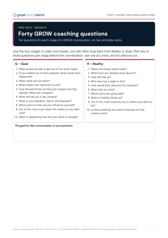
Forty GROW coaching questions
All forty questions on two printable cards, with space for the goal and the agreed actions.
Five mistakes that turn coaching back into telling
Questions that are really suggestions
“Have you thought about talking to finance?” is advice with a question mark. If you have an idea, ask permission and offer it openly (“I have a thought on this. Do you want to hear it?”), then go back to their options.
Rushing Reality
Managers who know the situation, or think they do, are tempted to skip to options. The person’s account of what is happening is where you learn what is actually in the way.
Leaning on “why”
“Why did you do that?” can sound like an accusation, however it is meant. “What led you to that?” or “What were you weighing up?” gets the same information without the defensiveness.
A Will with no date
“I’ll have a go at it” is not a commitment. A first step, a date and a review point are.
Coaching when the person needs direction
Someone new to a task, or in a crisis, may need you to tell them what to do. In our experience coaching works best when the person has some of the knowledge and needs to find their own way to use it. You can coach more as their confidence grows.
Where GROW fits
GROW suits performance conversations, development conversations, problem-solving and decisions. For a conversation about a problem with someone’s performance or conduct, prepare the facts first (see Four steps to an effective tough conversation) and use GROW for the part where you work out the way forward together. For a wider set of coaching moves, see Six ways to intervene when coaching. To plan a specific conversation, the free GROW conversation planner lets you choose your questions and print a one-page plan.
The GROW model was developed in the UK in the 1980s. Graham Alexander, Alan Fine and John Whitmore are each associated with its origins; it was first published in John Whitmore’s Coaching for Performance (1992). The questions on this page were written by great{with}talent from our coaching work with managers; many coaching question banks share questions of this general kind. For feedback that points forward, see FeedForward.
The clearest thirty minutes in your week.
Send us your current 360 framework and we’ll show you how it looks on FeedForward – no charge, no deck, no obligation. Or start with a pilot or a 30-minute conversation.