How to run a structured, competency-based interview.
The interview is the most widely used selection method there is, and the one most often run on instinct. Structure is what turns it from a conversation into evidence.
On this page
- Why structure matters
- Choose what you are assessing
- Plan the time: fifteen minutes per competency
- Build the rating form before you meet anyone
- Open well
- Probe for what they did
- Rate against the evidence, then write it up
- Question types worth having to hand
- The rating scale
- If several people interview
- Common mistakes
How to plan, open, probe and rate a 90-minute structured interview, with a printable plan and rating form.
Free download: Structured interview plan and rating form ↓Why structure matters
Every selection method differentiates between people. That is its job. The aim is to differentiate only on things that matter for the role, and to do it the same way for every candidate. An unstructured interview fails on both counts: different candidates get different questions, the conversation drifts towards whatever the interviewer finds interesting, and first impressions do the rest. A structured interview fixes the questions in advance, ties each one to a defined competency, and rates the answers against agreed indicators.
The evidence for doing this has strengthened. In 2022 Paul Sackett and colleagues re-analysed decades of selection research in the Journal of Applied Psychology, correcting for a statistical adjustment that had inflated earlier estimates. Structured interviews came out at the top of the list, with a mean operational validity of .42, ahead of job knowledge tests (.40), work samples (.33) and general cognitive ability tests (.31). Older summaries, such as Schmidt and Hunter’s widely cited 1998 table, gave higher figures and put work samples first (.54), with ability tests and structured interviews level at .51; those figures predate the correction.
Structure also protects the candidate. Asking everyone the same job-related questions is fairer, easier to defend if a decision is challenged, and a better advertisement for the organisation than a chat that feels like a lottery.
Choose what you are assessing
Start from the role, not the CV. Which three to five behaviours most separate someone who will do this job well from someone who will struggle? Use your competency framework if you have one; if not, the interview plan builder has twelve general competencies with definitions to choose from. If the process includes a test, a work sample or a presentation, give the interview the competencies those methods cannot reach, such as how someone handles a difficult relationship, rather than measuring the same thing twice.
Plan the time: fifteen minutes per competency
Two or three questions with proper follow-up take about fifteen minutes per competency. A ninety-minute interview therefore holds five at most: five minutes to open, five blocks of fifteen, ten minutes to close and take the candidate’s questions. Choose your two or three questions for each competency in advance and adapt the wording to the role (“a tough performance message to someone” becomes “to someone in your team” for a manager). If you need a technical question, plan the time for it.
Build the rating form before you meet anyone
For each competency, write down four or five positive indicators (what strong evidence sounds like) and their negative opposites. Pick indicators that matter for this role and that your questions can actually draw out. For “adapting to change”, for example: “explains the reasons for change to others” against “changes things without involving the people affected”. Agreeing these before the interviews is what makes ratings comparable between candidates and between interviewers.
Open well
Candidates do better, and you learn more, when they know what is coming. In the first five minutes:
- introduce yourself and your part in the process;
- explain that you will not walk through their CV but focus on a few areas critical to the role, and name them;
- explain that every candidate gets the same main questions so the process is fair;
- ask for real, recent examples and introduce STAR (situation, task, action, result);
- tell them it is fine if their mind goes blank;
- warn them you may move them on when you have enough, and that this is not a bad sign;
- say you will take notes.
Then warm up with an easy open question: “Tell me about the main responsibilities in your current role.”
Probe for what they did
Take one competency at a time and signpost it. Most first answers are about the team, the project or what they would generally do. Your follow-ups pull them back to a specific occasion and their own part in it: “What did you do?”, “What happened next?”, “How do you know it worked?”. Ask about limits as well as strengths: what went less well, and what they did about it. Keep your reactions neutral; “great example” tells the candidate what you want to hear. If an answer strays into another competency, note it for later and steer back. Before moving on, summarise what you have heard and ask whether there is anything they want to add.
Rate against the evidence, then write it up
As soon as the candidate leaves, review your notes and assign each piece of evidence to one competency only, so nothing is counted twice. Look for patterns across examples rather than one vivid story. Rate each competency on a five-point scale from outstanding to weak, and use “insufficient evidence” where the interview simply did not give you enough. Write up before you discuss the candidate with anyone else; details fade fast, especially after several interviews in a day, and a colleague’s view is hard to un-hear.
Question types worth having to hand
Behavioural questions do most of the work. The other five types help you open a topic, pin down the candidate’s own part and test what they learned.
| Type | Use it to | Example |
|---|---|---|
| Behavioural | Get a specific past example | “Tell me about a time you had to deliver a difficult message to someone in your team.” |
| Tell, explain, describe | Open up a topic without leading | “Describe how you planned that.” |
| Probing | Pin down their own part | “What exactly did you say? What happened next?” |
| Comparative | Reveal standards and self-awareness | “How does your approach compare with your peers’?” |
| Feedback | Bring in other people’s view | “What feedback did you get on how you handled it?” |
| Reflective | Test learning | “Knowing what you know now, what would you do differently?” |
The rating scale
Rate each competency on its own, against the indicators you wrote before the interview.
| Rating | What it means |
|---|---|
| 5 Outstanding | Strong evidence across all the indicators, consistently |
| 4 Strong | Strong evidence across most of them |
| 3 Acceptable | Good evidence on some, with minor gaps |
| 2 Marginal | Less than acceptable across most |
| 1 Weak | Less than acceptable across all, with no strengths shown |
| IE Insufficient evidence | You could not tell |
Keep IE separate from 1 on purpose: a 1 says the candidate showed weak evidence, while IE says the interview did not test the competency properly. That is a gap in the process, not in the candidate, and it should be filled (a follow-up question, a second interview, another method) rather than scored.
A useful way to think about it: each question is a pot the candidate can fill. A small pot that is full is good evidence; a large pot with a little in the bottom is not. And if the pot was never offered, the honest answer is IE.
If several people interview
Split the competencies between interviewers rather than all asking about everything. Each person rates their own competencies independently and in writing before the panel meets. Then discuss the evidence competency by competency, not candidate by candidate overall, and agree a rating for each. This is where structure pays for itself: the conversation is about what candidates said and did, not about who made the best impression.
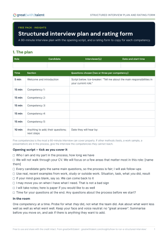
Structured interview plan and rating form
A one-page interview plan with the opening script as a checklist, and a rating form with indicator grid, evidence box and the rating key (1 to 5, plus insufficient evidence).
Common mistakes
- Too many competencies. Each one gets a single shallow question.
- Relying on hypothetical questions. “What would you do if…” used in place of real examples shows what people know they should do, not what they have done.
- Accepting “we”. Find out what the candidate personally did.
- Rating the person, not the evidence. Liking someone is not a competency.
- Writing up the next day. By then the third candidate’s best example has migrated to the first.
Drawn from great{with}talent’s interview guides for leadership and management roles and our general competency workbook, 2013 onwards. Validity figures: Sackett, P. R., Zhang, C., Berry, C. M. & Lievens, F. (2022), “Revisiting meta-analytic estimates of validity in personnel selection”, Journal of Applied Psychology, 107(11), 2040–2068. Build your own plan with the interview plan builder. For psychometric assessment alongside the interview, see FindingPotential.
The clearest thirty minutes in your week.
Book a walk-through with a real person, or start with a pilot or a 30-minute conversation.