Using a personality questionnaire at interview: from profile to questions.
A personality profile is most useful as a source of good interview questions. Here is how to read one against the job, turn what it suggests into hypotheses, and test them with evidence.
On this page
Six steps from job demands to tested hypotheses, with a question bank for seven trait areas.
Free download: Personality at interview: question planner ↓A personality questionnaire tells you how a candidate describes their own preferences at work. It does not tell you what they can do, or how they have learned to handle the parts of work that do not come naturally. The interview is where you find that out: it gives the candidate the chance to show how they use their preferences to good effect, with real examples, and how they cope where their preferences fit the role less obviously. It can be part of the main interview or a separate conversation; either way, it needs preparing.
Start from the job, not the profile
Take the three to five job demands you identified before choosing the questionnaire: the parts of the role that depend on how someone prefers to behave. If you skip this step you will find yourself discussing whichever scales look most extreme, which is interesting for you and irrelevant to the decision.
Read the profile against those demands only
For each demand, note what the profile suggests, including links between scales: a strong preference for structure combined with a high need to achieve may mean someone who sets demanding plans and is frustrated when they are disrupted. Note where the profile fits the role well, not just where it may not; you need evidence for strengths too.
Write hypotheses, not conclusions
Phrase each point as something to test: “may find frequent unplanned change draining”, “likely to be comfortable challenging senior colleagues”. Two to four hypotheses are plenty. If you find yourself with eight, you are interpreting the profile rather than preparing for an interview.
Turn each hypothesis into questions
For each one, plan an opening behavioural question that asks for a real, recent example; two or three probes to get at what the candidate personally did; and a strategy question. The strategy question is the one people forget, and often the most revealing: “When a situation like that is less comfortable for you, what do you do about it?” Plan to test the opposite as well. If the profile suggests someone prefers to work alone, ask for an example of when they chose to involve others.
Explain the purpose before you start
Candidates are often wary of personality questionnaires. Say that there are no right or wrong profiles, that the results describe preferences rather than abilities, and that you want to understand how they work and what they do in situations the role will bring. Then talk about work, not about scores. You do not need to show the profile; if you do share it, share it as their description of themselves, not as a finding.
Weigh the evidence with everything else
What you hear should supplement and challenge evidence from other stages, never stand alone. A preference the candidate manages well is not a weakness; a preference that fits the role is not proof of capability. Record what the candidate said they did against the job demand it relates to, and rate it with the rest of the interview evidence. If a hypothesis is still open at the end, explore it in a short follow-up rather than settling it by assumption.
A team leader role with frequent change
Job demand: reorganising work and rotas at short notice when demand or staffing changes. Profile suggests: a clear preference for routine and predictability, and a strong preference for planning ahead. Hypotheses: may find frequent unplanned change draining (to test); likely to plan carefully and keep standards up (a probable strength, also to test).
Opening question: “Tell me about a recent time your plans for the week were overturned at short notice.” Probes: “What did you do first?” “How did your team react?” “What happened in the end?” Strategy question: “When change comes without warning, what helps you get back on track?”
Good evidence sounds like: a specific occasion, a quick re-plan, attention to how the team was affected, and a deliberate habit the candidate has built, such as keeping a fallback rota. Weaker evidence sounds like: general statements about being adaptable, or an example in which others did the re-planning.
A question bank by trait area
Starting points only. Adapt them to the role, and ask every candidate for the role about the same areas.
| Trait area | Opening question | Probe or strategy question |
|---|---|---|
| Influencing and assertiveness | “Tell me about a time you argued for a view the rest of the group did not share.” | “How did the others respond?” |
| Working with new people | “Describe how you built a working relationship with someone you had not met before.” | “What do you do when meeting new people is less comfortable for you?” |
| Planning and organisation | “Talk me through how you planned a recent piece of work with a fixed deadline.” | “What system do you use to keep track of what needs doing?” |
| Rules and procedures | “Tell me about a time you thought a procedure was getting in the way of the work.” | “What did you do about it?” |
| Change and variety | “Describe a significant change to the way you work that you had no say in.” | “What helped you adjust?” |
| Composure under pressure | “Tell me about the most demanding period you have had at work in the last year.” | “What did you do to keep the work on track?” |
| Drive and standards | “Tell me about a time you went beyond what the role required.” | “What made you decide to?” |
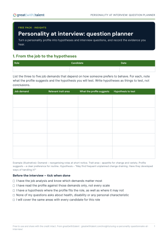
Personality at interview: question planner
A two-page planner: link job demands to hypotheses, then plan an opening question, probes and a strategy question for each, with space for the evidence.
Pitfalls
- Reading the profile back as a verdict. “Your profile says you’re not very organised” invites a defence, not evidence. Ask about the work instead.
- Labels. Calling someone an introvert, a perfectionist or a worrier tells you nothing new and can feel personal.
- Asking about health. Scales about emotional reactions or stress are about preferences at work, not health. Do not use them as a route to questions about anxiety, mental health or disability: under section 60 of the Equality Act 2010, which applies in Great Britain (England, Scotland and Wales), employers must not ask about a candidate’s health before offering the job, except for a few specific purposes. Ask about the demands of the role instead, as in the question bank above.
- Looking only for confirmation. Once a profile has suggested something, it is easy to hear only the evidence that fits. Planning to test the opposite is the guard against that.
Keeping it fair
Cover the same trait areas with every candidate for the role, keep the questions to the work, and make adjustments when a candidate needs them. Record what was said and how it fed into the decision. And offer every candidate who completed the questionnaire some feedback on their results, whatever the outcome.
For deciding whether and how to use a questionnaire at all, see before you use a personality questionnaire. For the wider interview method, see how to run a structured, competency-based interview.
Drawn from great{with}talent’s FindingPotential recruiter guide, feedback guidance and interview question sets (2009–2013), rewritten; questions are new or adapted from our own question sets. Legal reference: Equality Act 2010, s.60. Personality questionnaires with interview guides are part of FindingPotential.
The clearest thirty minutes in your week.
Book a walk-through with a real person, or start with a pilot or a 30-minute conversation.