The trouble with the feedback sandwich: praise on the spot, advice in its own time.
Praise, then criticism, then more praise. It is meant to soften the message. In practice the criticism gets lost and the praise stops meaning anything. There is a simpler pattern that keeps both parts working.
On this page
Praise on the spot, give advice in its own conversation, and know what helps when feedback is hard to hear.
Free download: The feedback card ↓Why the sandwich backfires
The sandwich survives because it feels kind to the person giving it. Wrapping a criticism in two compliments makes the conversation easier to start and easier to end. The trouble is what it teaches the listener. After the second or third time, a compliment from that manager becomes a warning: the “but” is on its way. Real praise stops landing because it sounds like a set-up. And the point in the middle is easy to miss or play down, because it arrives padded on both sides and the conversation ends on a high note that tells the listener things are fine.
Underneath is a simple confusion. Praise and advice are both called “feedback”, but they do different jobs. Praise tells someone what to keep doing and that it was noticed. Advice tells them what to do differently. Each works best on its own.
Praise on the spot
Praise works best close to the event. Say what they did, specifically, and why it mattered: “You took the angry caller off the team’s hands and rang them back the same afternoon. They have just renewed.” Then stop. Don’t add “one small thing”. If something does need improving, it can wait for a moment when the person can do something with it. Generic praise (“great job, everyone”) is easy to give and easy to ignore; the detail is what makes it believable.
Advice in its own time
Advice is better as its own conversation, at a time when the person can use it – before the next presentation, not straight after a bruising one. Keep it to one or two things. Ask for their view first (“How did you think the pitch went?”); people often name the problem themselves, and a point they raised is one they own. Describe one example you saw or heard yourself, say what effect it had, and talk about next time rather than last time. Finish with what they will try and when you will look at it together.
Checks for giving and receiving
Before you give feedback, check
- Can I name one recent, specific example I saw or heard myself?
- Is it about something they did, not who they are?
- Is this the right moment and place for them, not just for me?
- Am I saying it for their benefit, or to relieve my own frustration?
- Do I know what I would like them to try instead?
When you are on the receiving end
- Breathe before you answer. The first reply is often a defence.
- Ask for an example if there isn’t one.
- Say back what you heard, to check you heard it right.
- Thank them, even if you disagree. It took effort.
- Decide later, not in the room, what you will do with it.
Feedback to someone more senior
Upward feedback carries more risk, so the setting matters more. Five steps keep it useful:
- Ask first. “Can I give you a view on the Monday meetings?” A yes means they have chosen to hear it.
- Link it to something they want. “You said you wanted decisions made faster” frames it as help with their goal, not your grievance.
- Offer it as information. You see things from where you sit that they cannot: “From the team’s side, the agenda arrives after the meeting has started.”
- Ask what is going on for them. There may be a pressure you can’t see.
- Leave the decision with them, and notice – out loud – if anything changes.
When feedback is hard to hear
Even well-given feedback can hit hard. Reactions often follow a recognisable sequence, from surprise through to action. Not everyone shows every stage, the order can vary, and people can slip back. It is a short-form version of the change curve, for a single conversation rather than a long change. The point of knowing it is to recognise where the person is, and not to push for a plan while they are still taking the news in.
| Reaction | What you might notice | What helps |
|---|---|---|
| Surprise | They go quiet, ask you to repeat it, or answer something you didn’t say. | Stop adding points and let the silence sit. If they need longer, offer to pick it up again later the same day. |
| Push-back | Raised voice, “that’s not fair”, or questions about who else said it. | Let it run for a minute. Ask what feels unfair. You can respect the feeling without withdrawing the message. |
| Explaining it away | Reasons, context, other people’s part in it. Some of it may be true. | Agree with the parts that are true, then return to the one example: “Even allowing for that, what happened on Tuesday?” |
| Taking it in | Questions about the detail, “so what you’re saying is…”, a change in tone. | Let them lead. Ask what they would do differently next time, and offer your own idea only if theirs run out. |
| Moving to action | They start planning, or ask for help with a specific part. | Agree a first step and a date to look at it together. Acknowledge that it was not easy to hear. |
Two things to avoid. Don’t mistake silence for agreement; quiet often means surprise, and the real conversation is still to come. And don’t take back the message to calm the moment. You can say you understand it is hard to hear and still be clear that the point stands.
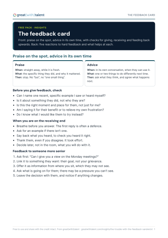
The feedback card
Two pages: praise on the spot, advice in its own time, with checks for giving, receiving and feeding back upwards; then the five reactions and what helps at each.
Written by great{with}talent from our consultants’ practice in feedback and coaching workshops. The five reactions follow the familiar change-curve pattern that descends from Elisabeth Kübler-Ross’s work with dying patients (On Death and Dying, 1969). For 360 feedback that points forward, see Stop feeding back, start feeding forward and FeedForward.
The clearest thirty minutes in your week.
Send us your current 360 framework and we’ll show you how it looks on FeedForward – no charge, no deck, no obligation. Or start with a pilot or a 30-minute conversation.