How to read and act on your 360 feedback report.
A 360 is the one time several colleagues are asked, in confidence, what you do well and what you could do better. It deserves more than a quick read and a sigh.
On this page
Decide nothing in the first hour. Read it twice, look for what rater groups agree on, choose up to three areas including a strength, and thank everyone who was invited.
Free download: 360 reflection worksheet ↓This guide is for you, the person whose report it is. If you can, work through your report with someone experienced in 360 feedback: a coach, someone in HR, or a manager who has been through it. They will spot patterns you miss and ask the questions you would rather avoid. Either way, the steps below are the same.
Set your context before you open it
Write down the three things you most need to deliver in the next 12 to 18 months, and the behaviours you will need most to deliver them. This gives you a filter. A report holds more messages than anyone can act on; your context tells you which ones matter now.
Read it twice
On the first read, just notice: what pleased you, what surprised you, what it confirmed. Then put it down and do something else. Feeling defensive, deflated or irritated at first is common. In our experience it eases with a little time, which is why it is worth deciding nothing in the first hour.
When you come back, look at your notes. If you focused on the criticism, re-read looking only for strengths. If you skimmed the praise and felt reassured, re-read looking only for development points. It is easy to read selectively the first time; the second read corrects it.
Look for themes, not authors
Comments are anonymous, but a turn of phrase or a reference to a particular meeting can make you think you know who wrote them. Resist working it out. You could be wrong, and even if you are right it changes how you treat that person, which is a quick way to make people less candid next time. Ask instead what the comments add to the ratings.
Find the agreements, then the differences
Look across your rater groups (manager, peers, direct reports, others). Where they agree, the message is strong. Note up to three consistent strengths and three consistent development areas.
Where groups differ, ask why. Your manager and your team see you in different situations, and both views can be accurate. Then look at the gap between how you rated yourself and how others rated you, and think about the possible reasons before deciding what it means.
Choose your focus
Pick up to three areas that matter most for what you need to deliver, and include at least one strength. Building on a strength is often the quickest return, and it keeps the plan from becoming a list of faults. For each area, list the benefits of getting better at it, generate as many possible actions as you can, then commit to one, with a date.
Close the loop
Thank everyone who was invited, not only the people you think responded: you should not know who did, and thanking everyone protects that. Then, if you feel able to, tell people what you took from it and what you are going to work on. It shows the feedback was worth giving, and it gives people permission to tell you how you are doing. What you share, and with whom, is your choice within whatever your organisation agreed at the start.
Reading the patterns
Some patterns come up in many reports. Here is what each might mean, and a question to ask yourself before deciding.
| What you might see | What it might mean | A question to ask yourself |
|---|---|---|
| Others rate you higher than you rate yourself | A strength you undervalue, or modesty in how you rate. | What would I do differently if I believed this? |
| You rate yourself higher than others do | A possible blind spot: your intentions are not landing as you mean them. | What might they be seeing that I don’t? |
| Your team and your manager see you differently | You may behave differently up and down, or each sees a different part of the job. | Where am I at my best, and with whom? |
| Comments say something the ratings don’t | A specific behaviour behind a general score. | What is the example underneath this? |
| Everything is in the middle | Raters may be cautious, or the questions may not fit your role. | Which comments are most specific? |
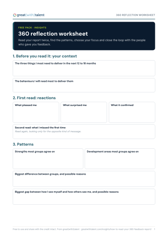
360 reflection worksheet
Two pages that follow the steps above: context, reactions, patterns, focus areas and closing the loop.
Three things to avoid
Arguing with the data
You can disagree with a rating, but it is still an accurate account of how someone experiences you. The useful question is not whether they are right, but what led them to see it that way.
Trying to fix everything
Ten actions become none. Two or three, done properly, change how people see you.
Going back to raters to ask what they meant
Asking your manager is usually fine. Asking peers or direct reports can make them feel exposed. If you want to understand a theme better, plan the conversation with your coach or HR first, and ask about the future (“What would help most?”) rather than the past.
To turn your chosen areas into goals you will keep, see Turning 360 feedback into goals. If you are the coach or manager taking someone through their report, see Running a 360 feedback conversation.
Drawn from great{with}talent’s workbook Making the most of your 360 (2021), rewritten for any 360 process. For a 360 built around forward-looking suggestions rather than scores alone, see FeedForward and Stop feeding back, start feeding forward.
The clearest thirty minutes in your week.
Send us your current 360 framework and we’ll show you how it looks on FeedForward – no charge, no deck, no obligation. Or start with a pilot or a 30-minute conversation.