How to handle a resignation conversation well.
Someone asks for “a quick word” and tells you they are leaving. What you say in the next five minutes shapes their notice period, the handover, and whether they would ever come back.
On this page
Listen, stay level and agree next steps; check a heat-of-the-moment resignation was meant; ask four questions before any counter-offer; then plan the handover and leave the door open.
Free download: Resignation conversation checklist ↓The first five minutes
Resigning is often uncomfortable, and the person may well have rehearsed it. Your job in the first conversation is not to solve anything. It is to listen, stay level, and agree what happens next.
- Thank them for telling you directly. “Thank you for telling me yourself. I’m sorry to hear it, and I’d like to understand.”
- Keep your reaction level. Surprise, disappointment or a flash of irritation are natural. Showing them now makes the next few weeks harder for both of you.
- Ask, and listen. “What’s prompted this?” “When did you start thinking about it?” “What are you going to?” You may hear the real reason now, or only later; either way, don’t argue with it.
- Don’t make an offer on the spot. In our experience a counter-offer made in the moment is rarely well judged. Say you would like to think about what they have said.
- Agree next steps. Ask them to confirm in writing if they have not already, agree when you will talk again (within a day or two), and agree that you will both hold off telling the team until you have decided together how.
Was it meant?
Occasionally people resign in the heat of the moment: after a bad meeting, an argument, a piece of news. GOV.UK advises employees who do this and change their mind to tell their employer immediately, and says the employer can choose whether to accept the resignation.
Law-firm guidance suggests that, where a resignation looks like a heat-of-the-moment reaction, the employer allows a short cooling-off period, a day or two, then checks whether the person meant it before treating it as final. Holding someone to words said in anger can lead to a claim, which is another reason to check. Don’t take a resignation said in anger at face value, and take HR advice if in doubt.
Notice, garden leave and the contract
Check the contract for the notice period and whether notice must be in writing. GOV.UK says that employees must give at least a week’s notice if they have been in the job for more than a month; many contracts require more. An employer may ask someone not to come in, or to work elsewhere, during their notice (garden leave), on the same pay and contractual benefits. Whether that, or paying in lieu of notice, is open to you depends on the contract: check before you offer either. This is practical guidance for managers, not legal advice; check notice, garden leave and pay with HR or your advisers before acting.
Should you make a counter-offer?
Sometimes. Losing someone good is expensive, and occasionally the reason they are going is one you can fix and should have fixed already. Before making any offer, answer four questions honestly.
- Is the reason something money fixes? If they are leaving because of their manager, a lack of growth, the workload or the culture, in our experience a pay rise buys time, not commitment, because the reason is still there.
- Would we have done this anyway? If the promotion or pay rise was deserved, the uncomfortable question is why it took a resignation. Fix that for everyone, not just this person.
- Is it fair to colleagues doing similar work? A pay offer that puts one person well ahead of peers in the same role creates a fairness problem, and possibly a pay-equality one. Check before you offer.
- What does it teach everyone else? If resigning is the reliable route to a pay rise, people will learn it.
If you do make an offer and they stay, treat the next few months like an onboarding: regular check-ins on whether the thing that was fixed is staying fixed. If they decide to go anyway, accept it gracefully. Pressure at this point is remembered.
Handover, and telling the team
List what the person holds: work in progress, clients and stakeholders, knowledge that lives only in their head, access and equipment. Agree who takes each item and by when, and build in introductions to clients and key contacts while the person is still there. Tell the team soon, agreeing the words with the leaver where you can; a team that hears it from the grapevine will often fill the gap with speculation.
Ask why, properly
The first conversation gives you their reasons as they are willing to tell their manager. To hear the fuller version, invite them to an exit questionnaire early in their notice, ideally at least three weeks before their last day, while they are still engaged and remember the detail, ideally run by someone outside the line of management. See Exit interview questions that get honest answers and How to choose an exit interview approach. If the same reasons come up from several leavers in one team, that is the place to act; stay interviews ask the people still there before they decide.
Keep the door open
People who leave on good terms can recommend you, refer others, become customers, and come back. In great{with}talent’s NHS leaver data, half of the leavers who left dissatisfied said they would consider returning (see Disappointed advocates).
So thank them properly on the way out, in front of the team if they are comfortable with that. Ask whether they would consider coming back in future, and how they would like to stay in touch. Record the answer somewhere you will find it when the right role comes up. A returner already knows the work and the culture, and the way you handled their leaving is part of why they would say yes.
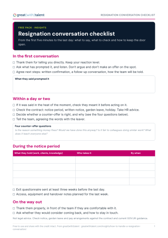
Resignation conversation checklist
A one-page checklist from the first conversation to the last day, with the four counter-offer questions.
Drawn from great{with}talent’s leaver research and exit-interview practice. Notice and garden leave: GOV.UK, Handing in your notice (giving notice; garden leave), checked 16 October 2026. Heat-of-the-moment resignations: GOV.UK (as above) and Stephens Scown LLP, “Dealing with heat of the moment resignations” (reviewed December 2023). This page is not legal advice. To hear honestly why people leave, see LastOpinion.
See what your own data already knows.
Send us your last twelve months of leaver data and we’ll show you what it reveals – no charge, no deck, no obligation. Or start with a free trial or a 30-minute conversation.