Measuring inclusion across the employee lifecycle.
Most organisations measure inclusion once a year, in the staff survey. That only hears from people who applied, joined and stayed.
On this page
What to ask at four stages, how to cut the results without exposing anyone, and what to do next.
Free download: Inclusion measurement checklist ↓The candidate who withdrew after a poorly handled interview is not in the staff survey. Nor is the new starter whose adjustments took six weeks to arrive and who left in month three, or the experienced colleague who resigned because promotions always seemed to go to the same kind of person. Measuring inclusion across the lifecycle means asking at each of those points, consistently enough to compare.
What to ask at each stage
Candidates
Ask after the decision, and include unsuccessful candidates and people who withdrew, because they are the ones whose experience you cannot otherwise see. Ask whether they were treated with respect and fairly, whether the process and its timescales were clear, whether they were offered adjustments and whether those were delivered, and whether they would apply again or recommend you.
Alongside the survey, track how each group progresses through the stages: application, shortlist, interview, offer, acceptance. A drop at one stage for one group is the single most useful finding a recruitment process can give you.
New starters
Ask at around eight to twelve weeks, the point our new-starter survey guide recommends; if you can, add a short check at about thirty days on whether adjustments and access were in place. Were agreed adjustments, equipment and access in place on day one? Did they feel welcome in their team? Did the reality of the job and the culture match what they were told when they were recruited? Did the organisation’s approach to inclusion come up at all during recruitment and induction? Early answers show whether the promise made at recruitment survives contact with a local team.
Employees
The annual or periodic survey. A useful structure has two halves:
- Organisational commitment: is the organisation open about its approach to inclusion; does it set and meet realistic expectations; do people have the support they need to be themselves; are policies visible, realistic and applied properly.
- Personal experience: how people are treated by colleagues and managers, whether they can be themselves and express their views, and whether they are treated fairly in pay, progression and recognition irrespective of who they are.
Add a question asking people which of these areas matters most to them, so you can see where poor experience coincides with high importance.
Leavers
Ask during the notice period, through someone independent of the line manager. Did the way they were treated, fairness in progression or a sense of not belonging play any part in the decision to leave – as a main reason, a contributing one, or not at all? Would they consider coming back? In our experience, leaver data often shows a pattern before the next staff survey does. The guide to exit interview questions covers the rest of the conversation.
Asking the demographic questions
None of this works unless people tell you about themselves, and they will only do that if they trust you. Make every monitoring question optional, with “prefer not to say”. Explain why you are asking, who will see what, and that results are reported only for groups, never individuals. Use the same categories at every stage so that you can follow a group from application to exit. Consider asking about caring responsibilities as well as the protected characteristics; in our experience it is often one of the most revealing cuts.
The data protection position
Much of this is special category data under UK data protection law. The Data Protection Act 2018 provides a specific condition for processing data about racial or ethnic origin, religious or philosophical beliefs, health and sexual orientation where it is necessary to identify or keep under review equality of opportunity or treatment (Schedule 1, paragraph 8), which usually also needs an appropriate policy document. It does not cover using the data for decisions about an individual. For candidates in Great Britain (England, Scotland and Wales), section 60 of the Equality Act 2010, which restricts health questions before a job offer, makes an exception for monitoring diversity among applicants. We suggest keeping candidate monitoring data well away from the people making selection decisions. Agree your lawful basis, retention periods and access with your data protection officer before you start.
Cutting the data safely
The value is in the breakdown. The risk is also in the breakdown. A few rules keep both in balance:
- Set a minimum group size and keep to it. Groups of fewer than five are typically not reported, and that is our own usual minimum. We suggest considering a higher threshold, such as ten, for demographic cuts, where a single answer is easier to trace.
- Watch the complement. If a team of fourteen has twelve women, reporting “women” also reveals the two men. Suppress the other group too, or report at a higher level.
- Look at intersections only where numbers allow. The strain is often heaviest where categories meet, but an intersection is only reportable when the combined group still meets your minimum.
- Combine with care. Merging small categories, or pooling two years, can make a group reportable. Say clearly when you have done it, and remember that merging, for example, every minority ethnic group into one can hide real differences between them.
- Check free text. Comments can name people, teams or circumstances. Read them before they are shared.
- Show the numbers. Report how many people each figure is based on, so readers do not over-read a small group.
Reading the results
Look for gaps between groups rather than the overall score; an organisation can improve on average while one group’s experience gets worse. Look for the stage at which a gap opens: applications that do not become shortlists, starters who do not settle, employees who do not progress, leavers who go unhappy. Use the importance question to prioritise: an area people rate as highly important and experience poorly is the place to start. And notice where many people answer “unsure” or “not applicable”; it often means they do not know what your policies are, which is itself a finding.
What to do next
Share what you found and what you will do about it. Pick two or three actions where the data points most clearly, give each an owner and a date, and say when you will report back. Then measure again with the same questions, so the comparison is real. For practical starting points once the results are in, see your inclusion results are in: ten places to start.
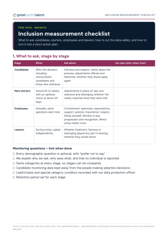
Inclusion measurement checklist
Two pages: what to ask at each stage with a planning column, monitoring and data-safety checklists, and a short action table.
Drawn from great{with}talent’s ED&I lifecycle model and our candidate, employee, leaver and taking-action analysis reports (2015–2023), rewritten as general method. Legal references: Data Protection Act 2018, Sch. 1 para. 8; Equality Act 2010, s.60(6)(c). In our own reporting, groups of fewer than five are typically not reported. For inclusion measured from candidate to leaver, see ED&I.
The clearest thirty minutes in your week.
Book a walk-through with a real person, or start with a pilot or a 30-minute conversation.