What to ask new starters, and when.
A new starter’s first months show whether recruitment told the truth and induction happened as promised. Without asking, the first sign of trouble is often a resignation.
On this page
When to ask, the seven areas to cover with example questions, and what to do with the answers.
Free download: New-hire check-in question sheet ↓Start with what you want to know
Four reasons for asking come up again and again in our work. Are new starters engaged, or already wondering whether they made the right move? Did the way we recruited them match the reality of the job? Is induction happening consistently, or only in some teams? And are we setting people up to perform: do they know what good looks like and how they will grow? If your early-leaver numbers worry you, or particular roles or sites keep losing people in their first year, those are the places to look hardest.
When to ask
We recommend sending the questionnaire at around eight to twelve weeks after someone starts. By then they have been through recruitment, induction and a couple of months of real work; recruitment is still fresh enough to remember; and if something is going wrong, there is time to put it right. Asking in week one tells you about the welcome and little else. Asking at a year tells you who stayed.
The first time you run it, invite everyone who joined in the last twelve months, not just this month’s starters. You get a baseline straight away, with more responses to compare teams, and you can look at results by length of service. After that, invite each person as they reach the eight-to-twelve-week point. If you want more, we suggest a short induction check at the end of the second week and a fuller conversation around the first anniversary.
The seven areas to cover
Keep it to ten or fifteen minutes. Ask only what you are prepared to act on, and use your own words for your own processes: the induction section in particular should list the steps your organisation actually promises.
About you, and why you joined
Who answered, so you can break results down later, and what drew them to you.
- “Which department or team do you work in?”
- “How did you first hear about the job?”
- “What most attracted you to the organisation? (choose one)”
Answer format: Pick lists. Keep demographic questions optional and separate.
Your recruitment
Whether the process was clear, fair and honest about the job.
- “I was kept informed about how long the process would take.”
- “The job description was accurate.”
- “The interviews felt relevant to the job.”
- “Overall, how would you rate your recruitment experience?”
Answer format: Agree–disagree for statements; excellent, good, okay or poor for the overall rating.
Your induction
Whether each step actually happened, and how well.
- “My manager met me on my first day.”
- “I had the equipment I needed from day one.”
- “Someone explained how to claim expenses.”
- “Overall, how would you rate your induction?”
Answer format: List your own induction steps; rate each satisfactory, unsatisfactory or did not happen.
Your expectations
Whether the reality matches what you told them.
- “How closely does the job match what you expected before you joined?”
- “How closely does the organisation match what you expected?”
Answer format: Very close, close, okay, poor, or I had no particular expectations.
Set up to succeed
Whether they know what good looks like and how they will grow. Where the gaps tend to be.
- “I am clear about what I need to deliver in my first year.”
- “I understand how my performance is measured.”
- “I receive regular feedback from my line manager.”
- “My line manager and I have agreed a development plan.”
- “I meet my line manager as often as I would like.”
Answer format: Yes, no or unsure. Simple answers make gaps easy to see and act on.
Your intentions
Whether they see a future with you. The single most useful question.
- “Which best describes you? I want to build my career here / I am undecided / I am unhappy and looking at alternatives / This job was always temporary for me / Circumstances outside my control mean I may have to leave.”
- “How long do you expect to stay?”
Answer format: One choice. The first answer is engaged; the next two are at risk.
Final thoughts
Their own words.
- “What do you enjoy most about the job?”
- “What do you like least?”
- “What one thing would most improve your performance?”
Answer format: Free text. Read every comment.
Two of those areas earn their place more than the others. The intentions question sorts new starters into those building a future with you, those who are undecided or unhappy, and those leaving for reasons you cannot influence. And the set up to succeed questions are where the gaps usually are: in our data, new starters are mostly clear about their role, but far fewer have an agreed development plan or know how their performance is measured. See what new starters tell us in their first months for the figures.
Anonymous, or named but confidential?
An anonymous questionnaire gives you group results only. A named one, where individual answers are seen only by HR, lets you also follow up with the people who need it. We recommend the named route, handled confidentially: in our experience it does not make answers less honest, and it is the only way to have a conversation with someone who is quietly deciding to leave. Whichever you choose, say exactly which it is. People forgive a named questionnaire; they do not forgive one that claimed to be anonymous and was not.
How to tell new starters it is coming
In our experience, how many people answer depends as much on what they were told about the questionnaire as on the questionnaire itself.
Mention it at induction
One line in the welcome pack or first-day session: at around ten weeks you will get a short questionnaire about how your start has gone, and here is what we do with it. It then arrives as something expected, not something to worry about.
Brief managers first
Tell them what it is for, who sees what, and that you would like them to encourage completion. Make clear they will see group themes, not individual answers, unless the new starter agrees.
Write a plain invitation
Say why you are asking, who runs it, how long it takes, exactly who sees individual answers, what happens with the results, and who to talk to if they would rather say something in person. Give a closing date.
Remind, then stop
Keep each invitation open for three or four weeks and send automatic reminders while it is open – for new-starter questionnaires we send them twice a week – to anyone who has not yet answered. When it closes, stop.
Subject: Tell us how your first few weeks have gone
You joined us recently and we would like to know how it has gone so far: how you were recruited, how your induction went, and how you are finding the job. It takes about ten minutes.
Your answers go to [the HR team / an independent organisation, name]. [Individual answers are seen only by HR, and nothing is shared with your manager without your agreement. / Answers are anonymous and reported only in groups.] We use the results to improve what we do for everyone who joins after you.
If you would rather talk to someone, contact [name, email]. The questionnaire closes on [date].
What to do with the answers
For individuals. Start with the people who are undecided or unhappy, and among them people in key roles or hard-to-fill skills. We suggest a conversation within two weeks of their answers. Be clear first about confidentiality and what happens to your notes. Ask what three things have helped most so far and what three have got in the way; then ask, “If we could do one thing to help you do well here, what would it be?” Summarise, agree a small number of actions with an owner and a date, and bring the line manager in only if the person agrees. Then check back; we suggest within four weeks.
For the organisation. Report the engaged, undecided and unhappy split, then break results down by department, site, role and manager, with a minimum group size so no one can be identified (groups of fewer than five are typically not reported). Look for hot spots where induction steps are not happening. Fix the must-dos first – anything to do with safety or someone’s ability to do the job – then the quick wins, then the longer projects.
Put the set-up-to-succeed results in front of managers, because many of those gaps are theirs to close. And compare the themes with what first-year leavers say in their exit interviews; where the lists match, you have your priorities. To read the same answers through an inclusion lens, see measuring inclusion across the employee lifecycle.
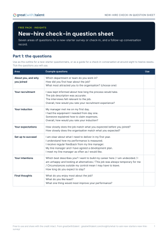
New-hire check-in question sheet
The seven question areas on one page, and a follow-up conversation record with actions, owners and a check-back date.
Pitfalls
- Too long. Every question you would not act on costs you responses.
- Too early. A week-one survey measures the welcome, not the job.
- Promising anonymity you cannot keep. In a small team, a role and a start date can identify someone.
- Changing the questions every year. You lose the trend.
- Asking and not answering. Tell each new intake what changed because of the last one; it is the best reason to answer.
For a manager’s-eye version of the same questions, try the early-leaver risk check.
Drawn from great{with}talent’s OnBoarder project handbook, new-starter communication factsheets and follow-up conversation guide (2010–2019), rewritten for anyone running their own new-starter survey. To run it with benchmarks and individual reports, see OnBoarder.
See what your own data already knows.
Send us your onboarding or new-starter data and we’ll show you what it reveals – no charge, no deck, no obligation. Or start with a free trial or a 30-minute conversation.