Career and development conversations: a manager’s four-step guide.
Plenty of managers can run a performance review but feel less confident asking someone where they want to be in five years – especially when the honest answer might be “somewhere else”.
On this page
Four steps make the conversation specific to the person in front of you: set the right horizon, decide what they should leave knowing, doing and feeling, ask better questions, and agree a strengths-first plan they will act on.
Free download: Career conversation prep sheet ↓A career conversation that works leaves the person clearer about where they are heading, and owning a plan to get there. One that doesn’t leaves them with a vague sense that their manager is “supportive” and nothing changed. In our experience, the difference is mostly preparation: knowing what kind of conversation this person needs, what you want from it, and which questions will open them up. This guide is the manager’s half. Its partner, Your development, your career, is written for the person you are talking to – send it to them beforehand.
The four steps
Get the focus right: freedom in a box
Not everyone needs the same conversation. Before you meet, give the person two quick ratings for their current role: energy (drive, commitment, appetite for more) and capability (do they deliver the role to standard?), each 0, 1 or 2. Add them up for a score out of four. The score tells you the size of the “box” – how much freedom, and how long a horizon, this conversation should have.
- 3–4, a big box. Look three to five years out. Let them drive the conversation; your job is mostly to ask and to open doors.
- 2, a medium box. Look twelve to twenty-four months out. Shared agenda: their aspirations, and what needs to be in place first.
- 0–1, a small box. Look three to six months out. Be more directive. Development here is mainly about getting the current role to standard, and it is still a development conversation, not a disciplinary one.
These horizons are our suggested starting points, not fixed rules.
The score is a planning aid for you, not a label for them. Don’t share the number; share the horizon. And re-score next time – boxes grow.
Make it unique: knowing, doing, feeling
Spend five minutes writing down what you want the person to leave the conversation knowing, doing and feeling. For example: knowing that a move into project work is realistic within a year; doing a draft plan by the end of the month; feeling that you take their ambition seriously. Then plan around it: how you will open, which time frame you will talk about, which questions you will ask, and what feedback you need to give. Finally, check the plan against your three lines. If nothing in it will make them feel taken seriously, change the plan.
Explore their aspirations
Pick one or two questions from each area below. Check them against the size of the box – ten-year questions are wasted on someone who needs a three-month focus – and against what you know of the person. Then ask, and listen far more than you talk.
Agree a development focus
Two principles shape the plan. Strengths first: building on what someone already does well is quicker, creates confidence and energy for harder development, and lets them repeat success; weaknesses that matter to the role still get attention, but they don’t get all of it. A blend of learning: the 70:20:10 rule of thumb says most development happens through the work itself (stretch assignments, new problems), some through other people (coaching, mentoring, feedback) and a little through formal courses. Treat it as a check on the blend, not a formula.
At the end of the conversation, ask the person to draft their own plan within two weeks. Then review it with them and be demanding: is the focus right for their aspirations, is the blend right, and are the actions specific enough to happen? After that, keep it alive in short, regular check-ins rather than a yearly form.
A question bank
Career aspirations
- If you could have any job in the organisation senior to yours, whose would it be, and why?
- Where would you like to be in two years? In five? In ten?
- What would you like your next role to be, and when do you think you’ll be ready?
- Which parts of what we do as an organisation connect with what you want for yourself?
- Outside work, what are you aiming for that we should know about?
The work, now and next
- What makes a great day at work for you? Name three things.
- How much are you learning in your current role?
- If you had to make a sideways move tomorrow, what would it be?
- Imagine a shelf stocked with skills and knowledge. You can take one thing today. What is it?
- What would it take for you to feel you were improving how things are done here?
- What is your reputation here, and why do you think that is?
- If you could drop the fifth of your job you enjoy least, what would go, and what would you do with the time?
- What change coming in the next year will affect your work most?
Being part of the team
- How do you see your role in the team? How could you contribute even more?
- If they made a film of your working life, who would be in the credits?
- How well do our team’s ways of working let you balance work and the rest of your life? What flexibility would help?
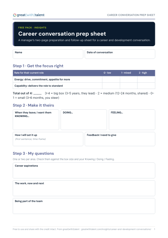
Career conversation prep sheet
A two-page prep sheet: the freedom-in-a-box rating, knowing / doing / feeling, your chosen questions, a 70:20:10 plan outline and the follow-up dates.
Pitfalls
- Doing the talking. If you have done most of the talking, you have been presenting, not exploring.
- Treating ambition outside the organisation as disloyalty. Someone who tells you they want to run their own business in five years has given you the most useful information in the conversation; the question is what they can learn here first.
- Writing the plan for them. A plan they wrote is a plan they own.
- Promising what you can’t deliver. Be honest about timescales and competition for roles; people cope with realism far better than with promises that quietly lapse.
If you want a quicker way into the conversation with someone who finds it hard to talk about themselves, the three-circle method starts from their own map of the job instead.
Drawn from great{with}talent’s manager development toolkit (career and development conversation step-by-step guide and webinar). 70:20:10 comes from Michael Lombardo and Robert Eichinger’s Career Architect Development Planner (1996), drawing on Center for Creative Leadership research into how executives learn, and is offered as a rule of thumb, not a research finding. For development feedback that faces forward, see FeedForward.
The clearest thirty minutes in your week.
Send us your current 360 framework and we’ll show you how it looks on FeedForward – no charge, no deck, no obligation. Or start with a pilot or a 30-minute conversation.