The pre-mortem: finding the four to six things your team must get right.
Many teams have a strategy and a long list of goals, and little in between. The missing layer is the handful of critical success factors that, if you get them right, make the rest follow.
On this page
Imagine it is a year from now and you have failed. Work back from the signs of failure to four to six critical success factors, state the assumption behind each, and track them on one canvas.
Free download: Pre-mortem: critical success factors worksheet ↓In our experience, strategies fail in translation more often than for lack of ambition: as managers and teams try to work out which of their many priorities actually matter, and end up busy being busy. Getting results needs three things working together.
- Alignment: a shared picture of where the organisation is going and why.
- Accountability: a local, owned version of that picture, with clear priorities.
- Adaptability: a rhythm of short, frequent check-ins that keeps the work on course as circumstances change.
Critical success factors sit in the middle. They connect the why of the strategy to the what of individual goals. Miss them out and leaders end up micro-managing projects. Manage by them and you can hold people to account for the strategy rather than for activity. They also make the team’s implicit assumptions explicit, which is where many strategies quietly go wrong.
Start from the vision and the mission
Write down what you aspire to be (the vision) and the specific outcome you are committed to, with a date (the mission). The classic illustration is the Apollo programme: a national aspiration to lead in space, and a mission to land people on the moon and bring them home safely by the end of the decade. The mission is concrete enough to fail at. That is what makes the next step work.
Run the pre-mortem
Ask the team: “It is twelve months from now and we have failed badly. What happened? What would we have seen?” Have people write their answers individually and in silence first, then share them. Stay with things within the team’s control; “the market collapsed” is a risk to note, not a success factor. Aim for quantity: twenty or thirty signs of failure is not unusual.
Ask why each would be so damaging
For each sign of failure, ask what impact it would have. This separates the embarrassing from the fatal, and it is often where the real priorities show themselves: several different signs turn out to lead to the same damage.
Cluster into four to six critical success factors
Group the signs and their impacts, and name what would have to go right to prevent each cluster. These are your CSFs: the four to six things that deserve most of the team’s time; a common rule of thumb is 80%. Write them as short, specific phrases: “new starters productive within six weeks”, not “people”. More than six and you have a list, not a focus.
State the assumption behind each one
For each CSF, write down what you are assuming to be true: about customers, capacity, other teams, timing. Make assumptions, because you have to, but keep checking them. A CSF built on an assumption that has quietly stopped being true is one of the commonest ways a sound plan goes wrong.
Turn each into goals
Only now set goals: what will be delivered under each CSF, by whom, by when. Every individual goal should trace back to a CSF. Any that do not are candidates for stopping.
Put them on one canvas, and keep checking
Score each CSF from 1 to 10 for where you are now and where you need to be. The gaps show where to put effort. Review the canvas at short, regular check-ins – a few minutes per CSF, often enough to change course – and when a CSF becomes business as usual, take it off and decide whether something should replace it.
Why imagining failure helps
Ask a team what it needs to do to succeed and you tend to get the plan they already had, in slightly different words. Ask them to explain a failure that has already happened and the conversation changes. Klein points to earlier research on “prospective hindsight” – imagining that an event has already happened – by Deborah Mitchell, Edward Russo and Nancy Pennington (1989), in which people imagining an outcome as certain came up with more reasons for it.
People who would not challenge a plan in a meeting will happily describe how it fell apart, because the question makes doubt legitimate. The quieter members of the team, and the ones closest to the work, often see failure modes the leaders miss.
Running it
Allow two to three hours for the first session with a team of up to ten; it fits well as one half of an away day. Use one facilitator who is not the most senior person in the room, so the leader can take part rather than steer. Have everyone write before anyone speaks. Capture the signs of failure verbatim. And finish the session with the canvas scored and the first check-in in the diary; a list of CSFs with no rhythm behind it is just a better-worded strategy document.
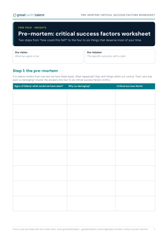
Pre-mortem: critical success factors worksheet
A two-page worksheet: the pre-mortem table, assumptions and goals for each CSF, and a strategy canvas to score now against target.
Common pitfalls
- CSFs that are really activities (“launch the new system”): ask what the activity is for, and make that the CSF.
- Too many: if everything is critical, nothing is.
- Nobody owns them: give each CSF a lead, and use a RACI chart if ownership is contested.
- No check-ins: without adaptability, alignment and accountability decay quickly.
Drawn from great{with}talent’s Speed to Performance method (critical success factors; alignment, accountability and adaptability). The pre-mortem as a named technique is credited to Gary Klein (“Performing a project premortem”, Harvard Business Review, September 2007); the term “strategy canvas” is borrowed from W. Chan Kim and Renée Mauborgne’s Blue Ocean Strategy (2005) and used here more simply. For the people side of putting a strategy into action, see Leading people through change; to measure strategy, structure and process alongside culture, see WinningFormula.
The clearest thirty minutes in your week.
Send us your last engagement survey and we’ll show you what it’s missing – no charge, no deck, no obligation. Or start with a pilot or a 30-minute conversation.