Running a senior team away day that changes something.
Too many away days produce a good day and a stack of flipchart sheets, and nothing changes. In our experience, the ones that do change how a team works are designed differently.
On this page
Design the day backwards from what the team should know, do and feel; build the agenda on what people said in interviews beforehand; and make sure something happens in the week after.
Free download: Senior team away-day planner ↓A senior team gives up a day or two together perhaps once or twice a year. It is expensive time, and too often it goes on presentations: each member reports on their area, the leader shares the strategy, and the conversation that the team most needs to have gets squeezed into the last half hour. Here is a way to design it differently.
1. Start with the impact, not the agenda
Before you plan a single session, write down how you want the team to leave, under three headings.
Knowing
A shared purpose; what each person’s part is in delivering it; what the team already does well; the reputation it wants to build; the culture and behaviours it needs; and the realities that every team has to work within or around.
Doing
Working even better together; showing more personal leadership; working within constraints – “given this constraint, what we need to do is…” – rather than waiting for them to go away; living the behaviours it agrees.
Feeling
Proud of what it has achieved; clearer about why it exists and where it is heading; more connected; trusted to take ownership; and, not least, that working here is still enjoyable.
Every session in the day should serve at least one line on that list. Any session that serves none of them – the update presentations, usually – can be a pre-read.
2. Interview everyone beforehand
Spend twenty to thirty minutes with each member of the team, one to one, two or three weeks before. Ask the same questions each time:
- What is our strategic focus for the next 12 to 18 months?
- What are the four to six critical success factors for achieving it?
- What are the strengths of the team and the organisation today?
- What could hinder success, internally and externally?
- What have been the main changes over the last year, inside the organisation and in the market?
- What would make the day worthwhile for you – and what must not happen?
The interviews do three jobs. They tell you where the team agrees and where it does not, which is where the agenda should spend its time. They surface expectations and resistance before the day, not during it. And they mean every person arrives having already been heard.
3. Choose the flow
A one-day flow that works well for a team that needs to reconnect and agree its purpose:
| Time | Session | How |
|---|---|---|
| 09:00 | Opening: why we are here | The leader sets the context and what the day is for. |
| 09:15 | The story so far | Small groups map the highs and lows of the last 12–18 months on a timeline; share in plenary. |
| 10:00 | What it takes to survive here | Aliens exercise: top five tips for succeeding in our team, and in the wider organisation. What do they say about our real culture? |
| 10:45 | Break | |
| 11:05 | Why we exist | Visioning, starting from “if we did not exist from tomorrow, what would happen?” |
| 12:45 | Lunch | |
| 13:30 | The reputation we want | What do we want key stakeholders to be saying about us in 12–18 months, and why does it matter? |
| 15:00 | How well we work together | Scaling: what puts us where we are, and what would one point better look like? (includes a break) |
| 16:40 | What we valued today | Turn what worked today into an agreed set of team behaviours. |
| 16:55 | Close | The leader’s closing thoughts and the first follow-up date. |
A two-day version suits a team that also needs to agree its priorities.
Day one. Context; the journey so far; understanding each other’s preferred ways of working; what makes a high-performing team, and the honest question of whether this is a team or a group; the reputation the team wants; its mission to a set date; and a first draft of the four to six critical success factors. Then dinner.
Day two. A check-in on day one; finalise the success factors and score how the team is already doing against each; the key deliverables and what comes first; the culture needed to deliver, using Aliens and then what to leave behind, hold on to and bring in; the team behaviours everyone will hold each other to; personal take-aways; close.
Aliens and scaling are described step by step in Eight team exercises that get people talking honestly. The timeline needs only a long sheet of paper: mark the last 12 to 18 months along it and ask small groups to add the highs and lows.
4. Facilitate it properly
The leader’s role is to open, close and take part, not to chair. If the most senior person facilitates, the team is likely to spend the day working out what the boss wants to hear. Use a facilitator from outside the team – another part of the organisation, HR or an external – who will hold to four rules: remain neutral; focus on process, not content; remember the group is the expert; and never do for the group what it can do for itself.
In practice that means:
- doing the research so you understand individual expectations and likely resistance;
- having a pre-meeting with one or two members if you need a better briefing;
- having the logistics sorted so they never become the story;
- controlling disruptive behaviour without creating hostility, and drawing out the quiet as well as containing the talkative;
- letting the group police itself through ground rules, roles and an issues log;
- staying calm and flexible when the plan changes;
- briefing and debriefing each session;
- and being yourself, with humour used sparingly.
5. Follow through within a week
The day is the start, not the outcome. Within a week, circulate a short write-up of what was agreed, with owners and dates – not a transcript of every flipchart. Put the first check-in in the diary before everyone leaves the room. And review the agreed behaviours at the start of each team meeting for the next quarter: a minute on “how are we doing against what we agreed?” keeps them alive far better than a laminated poster. The team wheel makes a useful before-and-after measure, scored at the away day and again three months later.
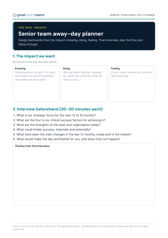
Senior team away-day planner
A two-page planner: knowing, doing and feeling objectives, the pre-interview questions, a flow grid, the facilitation checklist and the follow-through.
Drawn from great{with}talent’s senior team facilitation, including one- and two-day away-day designs, leadership pre-interview questions and our facilitation skills training. Organisations are not named. To bring the views of the wider organisation into an away day, see WinningFormula.
The clearest thirty minutes in your week.
Send us your last engagement survey and we’ll show you what it’s missing – no charge, no deck, no obligation. Or start with a pilot or a 30-minute conversation.