Leading people through change: what you will see, and what to do, at each stage.
People do not go through change in one step. They tend to move through recognisable stages, at different speeds. Recognise the stage and you know what kind of leadership to offer.
On this page
What you will see at each of the four stages, what helps, and how to plan for the dip.
Free download: Leading through change: the stage chart ↓Change plans tend to be built around the work: the new structure, the system, the timeline. The people side tends to be handled with a launch message and a set of FAQs, followed by surprise when the change stalls. What stalls it is often predictable. People tend to react to change in stages, and the leader’s job is to notice which stage someone is at and offer the kind of help that moves them on.
Six principles to start from
1. People need a compelling reason
Why this change, and what is in it for them and for their part of the organisation? If a manager cannot say it in two sentences, their team cannot either.
2. Change is a constant
Organisations move through a cycle – start-up, scaling, settling into routine, squeezing for efficiency, then either stretching the model or transforming it – and each stage asks something different of people. Knowing where you are explains a lot of what people are feeling.
3. It is a process, not an event
An announcement is the start of change, not the change. People go through it emotionally before they go through it practically.
4. Leaders have to work with ambiguity
You will not have every answer, and waiting until you do means engaging people too late. Keep checking your assumptions as you go.
5. Put the basics of performance in place
Alignment – a shared understanding of the big-picture why. Accountability – local goals people own. Adaptability – short, regular check-ins, feedback and noticing progress. The pre-mortem is a practical way to build all three.
6. Involve people – they are already involved
They are living the change whether or not you have invited them in. The only question is whether they shape it or simply react to it.
The four stages
Cynthia Scott and Dennis Jaffe described four phases people go through in a transition: denial, resistance, exploration and commitment. It is often drawn as a curve that dips through the first two and climbs through the second two, although Scott and Jaffe themselves drew a four-quadrant grid. They describe productivity falling in denial and dropping sharply in resistance, and energy returning in exploration. Use the stages as a guide to what help to offer, not as a timetable. People move at different speeds, a new announcement can send someone back a stage, and leaders are often a stage or two ahead of their teams simply because they heard the news first. What feels like old news to you may be fresh to them.
1. Denial – what they need: information
What you will see
The announcement has landed, but the work carries on exactly as before. People talk about the change as something for other teams, or for later. Few questions get asked, briefings are politely attended, and tasks linked to the change slide without comment. Some people throw themselves into the old way of doing things.
What helps
Make it concrete: what changes, for whom and from when. Repeat the essentials more often than feels necessary, and in more than one setting. Give people a small task that only makes sense if the change is real. Share what you know as you learn it, say plainly what you do not yet know, and avoid reassurances you cannot guarantee. Expect a reaction, and make time for it.
2. Resistance – what they need: a hearing
What you will see
The feelings arrive: anger, anxiety, sadness or cynicism. Complaints are as much about how the decision was made as about the decision. Mistakes, short tempers and time off can rise, and output wobbles. Some people argue; others go quiet and do the minimum. “We tried this before” is heard a lot.
What helps
Listen without trying to fix the feeling. Ask what people will miss, and mark the ending of the old way. Be clear about what is decided and what is still open, and ask for views on the open part. Hold the decision steady while you respect the reaction. Watch for anyone who is stuck for weeks rather than days, and offer them more support.
3. Exploration – what they need: focus
What you will see
Energy comes back, often in bursts. Questions turn to the detail of how the new way will work. Ideas arrive, some half-formed; people volunteer for pilots and compare notes. There is also confusion: too many things started at once, false starts, and frustration when an idea does not work first time.
What helps
Help people choose. Agree two or three priorities and short deadlines with something to show at the end. Provide the training and information they need to make good choices. Make it safe to try things and get some of them wrong. Get people sharing what is working, and say so when something lands.
4. Commitment – what they need: room
What you will see
People describe the new way as “how we do things”. They set their own goals within it, solve problems without escalating them and help colleagues who are finding it harder. Roles feel settled again, and attention turns to the next improvement.
What helps
Set longer-term goals with them rather than for them, and hand over ownership. Recognise what they contributed, in front of others. Ask them to support colleagues who are still earlier on. Review together what you would do differently next time, because there will be a next time. And watch for fatigue: the people who carried the change may need a lighter patch.
Planning for the dip
Most changes make things worse before they make them better. For a while people are learning a new way of working while still being judged on the results of the old one, and output, confidence and goodwill sag. Build that into the plan, and agree with your own manager how big a dip is acceptable and for how long, so that nobody mistakes it for a sign the change is failing. Three things make it shallower and shorter.
Talk more than feels necessary
Short, frequent and two-way beats one long announcement. When people are unsure, rumour fills the gap quickly; a standing fifteen minutes each week in which anything can be asked will do more than a polished set of FAQs. Sending isn’t communicating sets out how to plan it.
Give people something to finish
Long programmes offer little sense of progress. Break the early weeks into short goals that can be completed and seen, and say so when they are. Let the team choose some of those goals, so finishing them feels like theirs.
Treat objections as information
People who feel unheard keep repeating themselves. Give objections a proper hearing, the leadership team’s own included. Some will expose a real flaw in the plan: fix it, and say publicly which objection led to the fix.
Using this tomorrow
Pick the person or team you are least sure about and fill in one row of the fortnight planner in the pack. Note only signs you have actually seen, and the stage they point to. Choose two things from that stage’s “what helps”, and decide how you will check your reading: someone who works with them every day often sees what you cannot. Look at the row again in a fortnight. If nothing has moved, question the reading before you question the person.
The change reaction spotter turns the stage descriptions into a quick tick-list, and Eight team exercises includes two short exercises that open up the conversation about change.
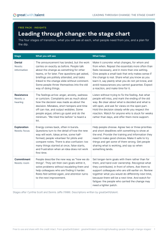
Leading through change: the stage chart
Two pages: the four stages, what you will see and what helps, the dip in three points, and a planner for your next fortnight.
Written by great{with}talent from our consultants’ practice. The four stages are Cynthia Scott and Dennis Jaffe’s (“Survive and Thrive in Times of Change”, Training and Development Journal, April 1988); the signs and actions are written by us. The change curve as a whole descends from Elisabeth Kübler-Ross’s stages of dying and grief (On Death and Dying, 1969), later borrowed by others for organisational change. The six principles come from our leading-in-change workshops (2016), and the organisational cycle in principle 2 is adapted from Peter Robertson, Always Change a Winning Team (2005). To see how people across your organisation are experiencing a change while it is happening, see WinningFormula.
The clearest thirty minutes in your week.
Send us your last engagement survey and we’ll show you what it’s missing – no charge, no deck, no obligation. Or start with a pilot or a 30-minute conversation.