Running an engagement survey: a practical implementation plan.
How many people respond, and whether anything changes afterwards, are decided mostly outside the questionnaire: before it, around it and after it.
On this page
A week-by-week plan from objectives to a six-month progress check: who to brief, how to lift responses, and how to turn results into a few owned actions.
Free download: Survey launch checklist ↓Start with the objectives, and the budget for what follows
Before anyone chooses a question, the senior team should agree, in writing, what the survey is for. Three questions get you most of the way: what do we want to know, what will we do with the answer, and who will own the action? Three to five objectives is plenty. Without them the survey lacks focus, action planning has nothing to aim at, and managers have no reason to support it. Agree the budget and time for follow-up at the same point. If nothing visibly changes after a survey, people have little reason to take part in the next one.
This plan covers running the survey itself, before launch and while it is open. For acting on the results once they are in, From survey results to action is the one-page action plan.
The plan, week by week
| When | What | Who |
|---|---|---|
| 8 weeks before | Agree the objectives in writing; confirm budget and owners for follow-up action | Senior team, HR |
| 7 weeks before | Settle the questions and add the organisation’s own language; decide the breakdowns and the minimum group size | Survey group |
| 6 weeks before | Choose how people will complete it (online, paper or both); plan access for people without a work email or desk; check dates against the business calendar | Survey group, IT |
| 4 weeks before | Name the survey; nominate champions; brief the senior team on their part | Survey group |
| 2 weeks before | Brief line managers; publish the FAQs; a senior leader announces it is coming | Survey group, managers |
| Launch | Invitation from a senior leader; the survey stays open for two to three weeks | Senior leader |
| While open | Weekly response updates by area (only for areas above the minimum); reminders in different formats and from different people | Survey group, managers, champions |
| Close | Thank everyone; share the overall response rate and when results will appear | Senior leader |
| 2–4 weeks after | Results to the senior team, then headline results to everyone, good and bad | Senior team |
| 4–8 weeks after | Team discussions and action plans; organisation-wide actions owned by the senior team | Managers, senior team |
| 3 and 6 months after | Progress update on what has changed; check whether the actions are having an effect | Senior team |
A suggested timeline. Compress or stretch the weeks to fit, but keep the order.
Four groups to brief
The senior team
Sets the objectives, commits to act and is seen to support the survey. Completion follows visible importance.
The survey group
Often HR and internal communications. Runs the process and the communications plan, and uses the senior team’s weight to drive it.
Line managers
Pivotal from first announcement to action planning: they shape how openly people answer and how seriously they take the follow-up, so brief them before anyone else hears about it.
Employees
Need to know what the survey is for, why their view matters, how to take part, and exactly who will see what.
What each group hears changes with the phase of the survey:
| Phase | Senior leaders say | Line managers hear and pass on | Employees hear |
|---|---|---|---|
| Planning | Why we are doing it; our commitment to act on the results; visible support | The objectives and timing; that responses go to an independent party; how they will be involved in action | What it is for; why their views matter; when and how to take part; exactly who sees what |
| While open | Taking part matters; people can be candid without comeback | Their area’s response rate; how to take part; time left | How to take part; how long it takes; time left |
| Results | Thanks; the overall response; what happens next | Their area’s results against the whole; how they will lead action | A summary of results, good and bad; the actions; how to get involved |
Raising the response rate
In our experience a large share of responses arrives in the first few days after launch; the rest needs reminding, more than once and in more than one format. The levers:
- Visible senior support, starting with an invitation from a senior leader rather than a system.
- Champions in each area who understand the purpose and encourage colleagues, briefed as a group of their own.
- Managers who give time to complete it, and never ask who has responded or what anyone said.
- Easy access: any device, no login, QR codes and paper where people lack a work email or a desk, and time during the working day.
- Sensible timing: avoid restructures, industrial disputes and the busiest point of the year, and aim for results to land before business planning.
- Questions in your own language, with a free-text question on the issues that matter locally, so people recognise the survey as theirs.
- An accurate promise about anonymity; see Anonymity and confidentiality in employee surveys.
- Varied reminders from different people: an email, a mention in team meetings, a poster, a text.
- Proof that it matters: one concrete thing that changed after the last survey. If your provider offers each respondent a personal report, that is a reason to complete too.
Results: decide the reports before the data arrives
Agree in advance who sees what: a summary for the senior team, team reports for managers whose teams clear the minimum group size, and a short version for everyone. The number of responses limits the breakdowns you can show; check them with the reporting threshold checker. Share results quickly, and share all of them. Publishing only the good news is noticed. Some organisations hold results back until actions are ready; the cost is a silence that people read as nothing happening, so if you wait, say when results will come.
Action: few, owned and measured
Give people time to digest the results before asking for action. Ask managers to work through their own team’s results with the team and agree one or two changes; have the senior team take and communicate the organisation-wide issues. Look for quick wins that cost little and show the survey was heard, and resist tackling everything at once. For every action, ask whether it will improve how people work or how customers are served, and how you will know. If it cannot be measured, think again. The engagement priority grid helps choose, and From survey results to action covers the conversation in more detail.
For every action, answer the same eight questions:
| Action plan field | The question to answer |
|---|---|
| Area for improvement | What is the problem? What effect is it having on people and customers? What is causing it? |
| What needs to happen | The specific change that will address it |
| How it will happen | The steps and the process |
| Timescale | A realistic completion date |
| Owner | The one person responsible for it happening |
| Resources | Money, people, materials or support needed |
| Target | The measure that will show it is working, such as the same survey items next time |
| Review date | When it will be reviewed, and by whom |
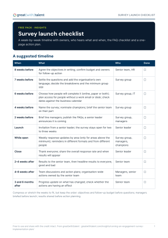
Survey launch checklist
The timeline as a checklist with owners, the who-hears-what matrix, an FAQ checklist and a one-page action plan.
Four pitfalls
- Launching without budget for follow-up, so the survey creates expectations nobody can meet.
- Running it in the middle of a restructure without saying why, which turns it into a referendum on the restructure.
- Too many actions, spreading effort so thinly that nothing finishes.
- Measuring once. Repeat the survey, leaving enough time for actions to take effect, so you can show whether they worked.
If the results keep saying the same thing, see why your engagement survey keeps saying the same thing.
Drawn from great{with}talent’s engagement survey implementation guide (2024), rewritten for any organisation running its own survey. The week-by-week timeline is our suggested sequence, not a fixed rule. WinningFormula runs engagement surveys with an expert results session included.
The clearest thirty minutes in your week.
Send us your last engagement survey and we’ll show you what it’s missing – no charge, no deck, no obligation. Or start with a pilot or a 30-minute conversation.