From survey results to action.
The survey closes, the report arrives, the presentation goes well. Six months later, ask a member of staff what changed. If the answer is a shrug, the next survey’s response rate will tell you so.
On this page
- Six steps from results to a plan
- Share the results quickly, unpolished
- Celebrate, improve, investigate
- Choose priorities by importance, not by score
- Filter the ideas: stop, reduce, raise, start
- Write it down: owner, date, measure
- Close the loop, more than once
- The rules that make it stick
- For managers with team results
Share the results fast, sort them into celebrate, improve and investigate, choose one or two priorities by importance, and give every action an owner, a date and a measure.
Free download: From survey results to action: one-page plan ↓Action plans rarely fail for lack of goodwill. They fail because the results are treated as the end of the process, because the plan tries to fix everything at once, or because the people who answered never hear what happened. Each of those is avoidable, and none of them needs a consultant. Six steps and a handful of rules stop it happening.
This is the plan for after the results arrive. For planning before and during the survey – objectives, timeline, briefings and response rates – see Running an engagement survey: a practical implementation plan.
Six steps from results to a plan
Share the results quickly, unpolished
Within two or three weeks of the survey closing, tell people what they said: the headline, the strengths, the areas that came out worst, and a few anonymised comments in their own words. Speed matters more than presentation. A month of silence reads as “they did not like what they heard”.
Celebrate, improve, investigate
Sort the results into three columns. Celebrate: what you do well and how to build on it – people need to hear that the good things were noticed too. Improve: the one or two areas where action would make working here better. Investigate: issues you do not yet understand well enough to act on, and how you will find out – a closer look at the data, or a conversation.
Choose priorities by importance, not by score
The lowest score is not automatically the priority. Pick the areas that matter most to your people and that they experience least well. If your survey did not ask about importance, ask now: a ten-minute exercise in a team meeting will do. The engagement priority grid plots it for you.
Filter the ideas: stop, reduce, raise, start
For each priority, list the ideas and sort them. What should you stop because it is not working or makes things worse? What should you reduce? What do you already do a little and should raise? What do you not do at all and need to start? Stopping something is often the quickest, cheapest and most visible action available.
Write it down: owner, date, measure
Each action gets one owner, a start date, a review date and a measure of success that someone outside the room would recognise. Keep the plan to a page. If it does not fit on a page, it will not get done.
Close the loop, more than once
Report progress at the first review date and again before the next survey. Use the language of the original comments: “You told us decisions felt like they came from nowhere. Since March, every team meeting starts with a two-minute update on what was decided and why.”
The rules that make it stick
Do:
- focus on what matters most to your people;
- share the results, good and bad;
- show people you have heard them, in their own words;
- commit to a small number of actions and carry them out;
- treat it as business work, with owners and dates, not an HR side project;
- build on what already works – quick wins earn credibility for the harder changes;
- involve people in designing the solutions;
- keep updating them.
Don’t:
- treat the survey as the end point;
- disappear into rounds of focus groups – your people have already told you what would help, and asking again without acting feels like stalling;
- over-commit.
And if there is something you are not going to do – a pay rise that is not affordable, a policy that will not change – say so at the outset and explain why. People accept a straight no far better than a vague maybe that never arrives.
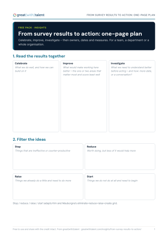
From survey results to action: one-page plan
Two A4 pages: celebrate / improve / investigate, the stop–reduce–raise–start filter, the action table, and the dos and don’ts.
For managers with team results
If you have your own team’s results, run the first two steps with the team rather than for them. Thirty minutes is enough: share the results, ask “what surprises you?”, agree one thing to celebrate and one to improve, and ask the team for the action. A plan the team wrote is a plan the team will hold you to. For a structured way to run that conversation, the snowball exercise in Eight team exercises that get people talking honestly works well.
Drawn from great{with}talent’s action-planning toolkit for engagement surveys (2016–2025). The stop–reduce–raise–start filter adapts Kim and Mauborgne’s eliminate–reduce–raise–create grid. WinningFormula asks every respondent which action would make the most difference, so the plan starts with their suggestions.
The clearest thirty minutes in your week.
Send us your last engagement survey and we’ll show you what it’s missing – no charge, no deck, no obligation. Or start with a pilot or a 30-minute conversation.