Starting a new team or project: a charter and kick-off checklist.
Many new teams start with a meeting about the work and never discuss how they will work. Six weeks later the same questions surface as friction: who decides, who tells whom, what counts as done.
On this page
Check first whether you need to be a team at all. Then settle what the sponsor must answer before kick-off, and have the team write a one-page charter it reviews at 30 and 90 days.
Free download: Team charter and kick-off checklist ↓There are two jobs to do before a new team or project gets going. The sponsor and the team leader need to answer a handful of questions only they can answer. Then the team needs to agree, in its own words, how it will work. The first is a checklist; the second is a charter. Before either, ask one honest question.
First: are you a team or a group?
A team exists when people cannot succeed without each other: there is a goal none of them can achieve alone, and if one misses, the others fail too. Plenty of “teams” are really working groups – a manager’s direct reports each running their own area, meeting to share updates. There is nothing wrong with that. The trouble starts when a group is told to behave like a team: hours go on joint working that adds nothing, and people come to resent meetings that keep them from the work they are actually measured on.
Three questions settle it:
- Is there a goal none of us can achieve alone?
- If one of us misses, do the others fail too?
- Would we lose something real if we met only to share updates?
If the answers are mostly no, stop manufacturing teamwork. Katzenbach and Smith’s point was that a working group is a legitimate way to organise, not a team that has failed, and it is run well in a different way. Manage people one by one: agree with each person what they are accountable for and what helps them do their best work. Let each of them own goals that visibly serve the organisation’s. Name the handful of hand-offs between you and agree who handles each. And keep meetings short, spending them only on what affects more than one person.
If the answers are mostly yes, carry on: an hour or two at the start settles the questions that otherwise surface later as friction.
Before kick-off: what the sponsor must answer
These are the questions that sink teams when nobody answers them. The sponsor owns the answers. Write them down before the first meeting, and say plainly at the kick-off which are still open and when they will be settled.
Why, and how far
In two sentences: what problem is this team here to solve, and why does it matter now rather than next year? Then draw the edges. Say what is inside the remit and, just as important, what is outside it, and get the sponsor to sign that off. A team that cannot say why it exists will spend its first month finding out.
What done looks like
Describe the world after the team has finished. Some of it can be counted; for the rest, agree now what evidence you will accept, because arguing about it at the end is too late. Tie each outcome to an organisational objective, so the team can defend its time when priorities collide. Then fix the hand-over date, the checkpoints on the way and who signs each one off.
Who, and how much
Say why each person is on the team: what they bring that it could not do without. Spell out what the leader, the sponsor and any facilitator will actually do, week to week. Then put a number on time. How many hours a week, or days a month, is each person giving, and has their own manager agreed in writing? Which meetings does each person really need to attend? People who do not know why they are in the room tend to behave like visitors, and unagreed time commitments are a common reason cross-functional teams stall.
The charter: one page the team writes together
A charter is a working agreement, written by the team at its first or second meeting, ideally in a facilitated session of two to three hours. It covers ten things, in three groups.
Purpose
- Why we exist – in a sentence or two, and the organisational objective it serves.
- What we own – the outcomes the team answers for, and the one or two tasks that cannot slip.
- Our goals – for each, who leads it, the date it is due and the evidence that will show it is done.
People
- Who we are – what each person brings and who does what. A RACI chart helps if responsibilities overlap.
- How we behave – three to five behaviours you could see or hear.
- How we handle disagreement – including who calls time on a debate.
Process
- Our meetings – which ones you hold, what each is for, who really needs to be there and where decisions are recorded.
- How we decide – and who decides, by when, if you cannot agree.
- How we stay connected – who outside the team needs to hear from you, and how often.
- How we keep improving – when you stop to review the way you work, not just the work.
What makes a charter worth having
Behaviours, not values
“Honesty” on a charter changes nothing. “We raise disagreement in the meeting, not after it” can be seen, praised and called out. Write every behaviour so that a newcomer would know whether it was happening.
A decision rule with a fallback
“We decide by consensus” is fine until the day you cannot reach one. Add who decides, and by when, if you do not agree. That one sentence prevents a lot of the stalemates new teams suffer.
Keep it to one page
If it runs to three, nobody will open it again after the first month. Cut anything the team would do anyway, and keep the lines that settle an argument you can see coming.
The team writes it
A charter drafted by the leader and circulated for comment is a memo. The value is in the argument about the wording.
Review it at 30 and 90 days
Treat the first version as a hypothesis. Ask what is working, what you have quietly stopped doing, and what you need to add. The team wheel makes a good structure for the 90-day review, and the pre-mortem is a sharp way to test the goals before you commit to them.
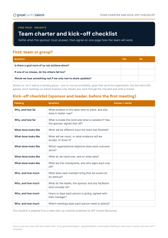
Team charter and kick-off checklist
The team-or-group test, the sponsor’s kick-off checklist and a one-page charter template.
The pitfalls
An absent sponsor, so scope drifts and nobody can say no. Goals nobody can measure. Members whose managers never agreed to release their time. And a charter filed after the first meeting and never seen again. Each is avoidable in the first fortnight and expensive afterwards.
Written by great{with}talent from common team-chartering practice; the sponsor checklist is adapted from a team start-up checklist published by MIT Human Resources. The distinction between a team and a working group follows Jon Katzenbach and Douglas Smith, The Wisdom of Teams (1993). For a picture of how teams across your organisation experience their working environment, see WinningFormula.
The clearest thirty minutes in your week.
Send us your last engagement survey and we’ll show you what it’s missing – no charge, no deck, no obligation. Or start with a pilot or a 30-minute conversation.