Eight team exercises that get people talking honestly.
Ask a team “any concerns?” and you will often get silence. Give people a structure that makes it safe and a little bit fun, and you will hear what they are actually thinking.
On this page
Eight exercises, most under an hour, each with its purpose, timing, materials, steps, debrief questions and what the leader does afterwards. Pick by what you need, using the guide below.
Free download: Eight team exercises: facilitator cards ↓Each exercise below is written so a manager can run it tomorrow: what it is for, how long it takes, what you need, the steps, the debrief questions and what you do afterwards. The last part matters most. An exercise that surfaces honest views and then leads nowhere teaches people not to bother next time.
Choosing one. To open up a hot topic or an announcement: the snowball fight. For a new team: the personal shield. To land messages with a large group: market stalls. To start a conversation about change: how do I react to change, or back to back. To get at culture and values: Aliens with a small group, World Café with a large one (Two ways to define your organisation’s values shows where each fits in a values project). To review how well the team works without blame: scaling.
1. Snowball fight
Steps
- Explain that you want an open, honest conversation, and that this is a way for people to say what they think anonymously.
- Write three or four questions on the flipchart. For the year ahead: what are you most looking forward to? What worries you most? What is everyone talking about that nobody asks in public? What questions do you have? After a big announcement: how has it left you feeling? What are your hopes? Your concerns? Your questions?
- Each person tears a sheet into as many pieces as there are questions, writes one answer on each, and screws each one into a ball.
- Count down and let the snowball fight run for thirty seconds.
- Everyone picks up the same number of snowballs. Go round the room, reading them aloud one at a time, letting each be heard before the next.
Debrief questions
- What surprised you?
- How do you feel about what was shared?
- Does anyone want to add anything?
- What is one thing each of us could do to move forward?
- How can I help?
What the leader does
Speak last. Never try to work out who wrote what. Capture themes and questions as you go. Thank people, summarise what you heard – including the feelings, not just the facts – and say what you will do and when you will come back on questions you cannot answer today. Where an issue cannot be solved, the outcome can still be “given that constraint, what we will do is…”. The same format works for discussing survey results: what surprised you, what should we keep, what should we change, and one action for the next few weeks.
2. Personal shield
Steps
- Each person draws a shield and divides it into sections.
- In the sections they answer: something you don’t know about me; what I hope for from this team; me at my best as a team member, and at my worst; what I want from today; the biggest challenge I face at work; my claim to fame; three or four values that matter to me; and a personal motto.
- Everyone puts their shield on the wall with their name on it.
- People walk round, read each other’s shields and ask questions.
Debrief questions
- What surprised you most?
- What do we have in common?
- Where might our differences cause friction, and where are they a strength?
- What do the “at my worst” answers tell us about how to support each other?
What the leader does
Draw yours first and be candid: your shield sets the depth for everyone else’s. Change the prompts to suit the purpose of the meeting. Leave the shields up for the rest of the session and refer back to them.
3. Market stalls
Steps
- Split the audience into groups of six to ten, each starting at a different stall.
- On the first whistle, each stallholder has ten minutes to “sell” their message. No slides; a flipchart sketch is fine. The group listens without interrupting.
- On the second whistle the group has five minutes for questions and views.
- On the third, groups move to the next stall. Repeat until every group has visited every stall.
- Groups then discuss among themselves the key messages, how they feel about them and what they still want to know.
Debrief questions
- Which messages landed, and which did not?
- What questions are still open?
- How do people feel about what they heard?
What the leader does
Stallholders prepare thoroughly and keep exactly to time, or the rotation collapses. Do not let one voice dominate the questions. Note the questions from every round: the pattern tells you what has been understood and how people feel. Publish answers to the open questions within a week.
4. How do I react to change?
Steps
- Put up four signs completing the sentence “Change to me is most like…”: a new pair of shoes; a thunderstorm; a roller coaster; a chocolate pudding.
- Ask everyone to stand by the one that fits them best.
- In each group, people say why they chose that one and not the others.
- Each group shares a short summary with the room.
Debrief questions
- What does this tell us about how we react to change?
- What is the risk if I see change differently from the rest of the team?
- How could knowing this help us support each other?
What the leader does
Say where you stand and why. Treat the thunderstorm corner as information, not a problem to fix. The learning to draw out: people see change differently and so behave differently; that difference easily turns into frustration with each other; understanding it is the first step to supporting people through it.
5. Aliens
Steps
- Announce that aliens have landed and are coming to work here.
- In small groups, list the top five tips you would give them to survive and succeed.
- Each group shares its list.
- Ask: what does this list tell us about our real values, spoken and unspoken?
Debrief questions
- Which tips are we proud of?
- Which would we like to stop being true?
- How do the lists compare with our stated values?
- Do different groups, functions or sites give different tips?
What the leader does
Do not defend anything that comes up; the tips that sting are often the most useful. Record them word for word. It works well with an executive team drafting values, and for comparing two cultures after a merger.
6. World Café
Steps
- Run one question per round, 20–30 minutes each. After each round everyone except the table host moves to a new table.
- The host summarises the previous conversation and the new group builds on it.
- Questions that work for culture: what are we like at our best? At our worst? What should we take forward, leave behind and introduce? Given all that, how would we describe our core values?
- Close with a harvest: each host reports the themes from their table.
Debrief questions
- Which themes came up at every table?
- What surprised you?
- What is missing?
What the leader does
Say at the start what will happen to the output – for example, that the executive will finalise the wording – and then do it. Participation with no visible result breeds cynicism. And remember that defining values is the easy part; living them is the work.
7. Back to back
Steps
- People pair up and stand back to back.
- Each changes one thing about their appearance in ten seconds, then they turn round and spot the difference.
- Repeat with two changes in fifteen seconds, then ten changes in forty-five seconds.
- Ask who managed ten, and who spotted every change.
Debrief questions
- Which round was hardest, and what went through your head?
- In the early rounds, did people add things or take them off?
- Where in our own change are people still at the taking-off stage?
- What would have made the ten-change round easier?
- What does that suggest we do for the people our change affects?
What the leader does
Watch, then describe what you saw. In the early rounds people typically remove things – a watch, glasses, a jacket – which is a fair picture of change being felt first as loss. Additions tend to appear only when there is nothing left to take off, and the last round brings protests and the odd refusal: the reactions a real change provokes, in miniature. Make it easy for anyone to sit out, and make clear nobody needs to remove anything they would rather not.
8. Scaling
Steps
- Agree what 10 would look like for the topic.
- Agree where the team is now, say 6.5.
- Ask: what puts us at 6.5 and not at zero? Name seven strengths.
- Ask: what would tell us, and others, that we had climbed one point? Name five signs.
- Choose the sign that would add most value, and agree the action, the owner and the date.
Debrief questions
- What did we learn about what is already working?
- Did we see the score the same way?
- What is the one action, and who owns it?
What the leader does
Resist jumping to problems: the method works because it starts from what is working. Aim for one point, not ten. Revisit the score in a month.
Three rules for all of them
- Say what happens next before you start. People are more open when they know what will be done with what they say.
- Take part. A leader who watches from the side turns an exercise into an assessment.
- Close the loop. Summarise, commit to your own actions, and come back with answers by a date you name. If you are discussing survey results, From survey results to action covers what to do with the output; for a team review, the team wheel gives the conversation a structure.
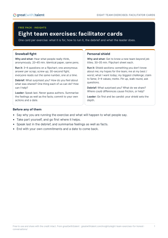
Eight team exercises: facilitator cards
Eight facilitator cards, one per exercise, plus a planning box. Print, cut and keep in your notebook.
Drawn from great{with}talent’s management toolkits Engaging your people and Building a high-performing team (2013–2016). The back-to-back exercise is a widely used change-workshop activity. World Café is a widely used open conversation format developed by Juanita Brown and David Isaacs; scaling questions come from solution-focused practice. For teams going through change, see Leading people through change. To hear from a whole workforce rather than one room, see WinningFormula.
The clearest thirty minutes in your week.
Send us your last engagement survey and we’ll show you what it’s missing – no charge, no deck, no obligation. Or start with a pilot or a 30-minute conversation.