Is it the person or the job? A performance problem diagnostic.
Before you sit someone down about a performance gap, check whether the job is set up for them to succeed. Thirty-five questions show where the cause most likely sits.
On this page
Answer 35 quick questions about one person and one task; get the likely causes, what to fix first, what is within their control and who else to involve. Nothing is stored.
Free download: Performance problem diagnostic ↓Why diagnose before you discuss
When someone’s work falls short, the instinctive explanation is about the person: they can’t, or they won’t. Sometimes that is right. Often the cause sits in the job around them – a standard nobody wrote down, two people giving conflicting instructions, feedback that arrives months late, a system that doesn’t work, or a quiet incentive to do the task badly. Managers tend to reach for ability or attitude first – in our experience partly because the person is visible and the situation around them is not.
Go into the conversation with that assumption and you will spend it defending your diagnosis rather than fixing the problem. The checklist above is a disciplined way to look at the situation first. It draws on the performance analysis approach set out by Robert Mager and Peter Pipe – work through the possible causes before you choose a remedy – rewritten for the way work is organised now.
Check the legal side first
Are there any legal implications to this performance issue? If it might touch on disciplinary or capability procedures, health, disability, discrimination, a protected disclosure or a probation decision, talk to your HR adviser before the conversation. How the first conversation is handled can matter later, and HR would rather hear from you early.
The six areas
| Area | The question underneath | Typical fixes |
|---|---|---|
| Knowledge and skill | Could they do it if their job depended on it? | Practice, coaching, a job aid, retraining |
| Standards | Do they know what good looks like, and does everyone agree? | Write the standard down; align everyone who gives instructions |
| Measurement | Can anyone, including them, see the gap? | Measure results, objectively, and share the measure |
| Feedback | Do they hear how they are doing, soon enough and specifically enough? | Regular, specific feedback tied to what they control |
| Conditions | Does the job let them do it? | Fix time, tools, information, authority and workload |
| Incentives and consequences | What happens to them when they do it well, and when they don’t? | Remove hidden penalties; make good work count |
The quickest test of all: could they do it if their job depended on it? If the honest answer is yes, this is not a skill problem and training will not fix it – look at standards, feedback, conditions and consequences. If the answer is no, ask whether they could ever do it. If they once could, they need practice and feedback. If they never could, they need to be shown.
Reading the result
The profile ranks the six areas by the share of your answers that point to a possible cause (a “No” counts fully, a “Not sure” half). Any area with at least one “No”, or two “Not sure” answers, is flagged, and the top one or two flagged areas are shown as the likely causes. Treat them as hypotheses to test with the person, not conclusions. Three things to take from it:
- What to fix first. If the leading cause is in the job – standards, measurement, feedback, conditions – fix that before you discuss their performance. Holding someone to a standard nobody wrote down feels unfair because it is.
- What is within their control. Skill sits partly with the person, and so does the motivation side of incentives – but the consequences that drive incentives are yours to change. Everything else sits mainly with you or the organisation. Be clear in your own mind which is which before you walk in.
- Who else needs to be involved. Many causes belong to someone else: the owner of a system, a second manager giving conflicting instructions, whoever allocates work. A conversation with them may matter more than the one with your team member.
Then have the conversation, and bring the diagnosis in as a question rather than a verdict: “I’ve been looking at what might be getting in the way – here’s what I found. What have I missed?” Four steps to an effective tough conversation covers the preparation and the conversation itself.
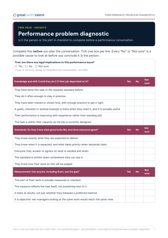
Performance problem diagnostic
The same diagnostic on paper: the legal question, all six areas and space to note causes, what is within their control and who else to involve.
Drawn from great{with}talent’s management toolkits (the tough conversations personal diagnosis tool, 2013). The checklist draws on Robert Mager and Peter Pipe’s performance analysis (Analyzing Performance Problems); items are rewritten in our words. For the conversation itself, see Four steps to an effective tough conversation; for development that faces forward, FeedForward.
The clearest thirty minutes in your week.
Send us your current 360 framework and we’ll show you how it looks on FeedForward – no charge, no deck, no obligation. Or start with a pilot or a 30-minute conversation.