Speak up or stay silent? A decision check for a hard conversation.
You have noticed something you think should be said – to a peer, to your manager, to someone well above you – and you cannot decide whether saying it is worth what it might cost.
On this page
Rate the worst, best and most likely outcome of speaking up and of staying quiet, add a gut score, and get a recommendation and a plan for the first two minutes. Nothing is stored.
Free download: Speak up or stay silent? Worksheet ↓Why silence wins by default
Staying quiet is the easy default, and it is easy to see why. The cost of speaking up is immediate and personal: an awkward moment, a strained relationship, the chance of being seen as difficult. The cost of silence arrives later and is spread thinly – a problem that grows, a team that works round it, a relationship that cools without anyone saying why. Because one cost is vivid and the other is vague, the decision is often made by the vivid one.
This check puts both on the table. It works for a manager wondering whether to challenge a well-regarded colleague, for someone deciding whether to tell their own manager something unwelcome, and for anyone who has seen something that does not sit right with them.
How the check works
Name the point
Write what has happened in a sentence or two. Then answer one question: leave aside the worry about how it will land – what is the one point you need them to understand? If you cannot get it into a sentence, you are not ready to say it yet. Add what you would like to be different afterwards; that is your aim, and it keeps the conversation from turning into a list of grievances.
Play both futures forward
For each route – raising it and staying quiet – note the worst thing that could realistically happen, the best, and the most likely. Do all six. It is common to think hard about the worst case of speaking and hardly at all about the worst case of silence. Then rate each box: could you live with the worst case, how much would the best case improve things, and would the most likely result leave things better or worse than now?
Check your gut, then choose on purpose
Give a gut score from 0 (definitely not worth the risk) to 10 (definitely worth it). The tool compares the two columns of your grid – the most likely outcome counts double, the best and worst cases once each – and sets the result against your gut score: 6 or above counts as yes, 5 as undecided, 4 or below as no. If the worst case of speaking up is something you could not live with, it says so before anything else.
Whatever it says, make the choice on purpose. There are three honest ones:
- Raise it now.
- Raise it later, on a date you set – once you have the example, the moment or the ally you need.
- Let it go – properly, without keeping score.
The choice that rarely works is staying quiet while still carrying it around.
If you raise it, plan the first two minutes
- Keep it to one issue. If a second complaint is sitting in your notes, save it for another day. Raise two at once and they will answer the easier one.
- Start from what you both want. A team that holds together, a project that lands, a customer who stays. It tells them why you are raising it before they have time to guess.
- Use one precise example. What happened, when, and how often. “Always” and “never” start an argument about the exception.
- Say the effect, then what happens if nothing changes. Illustrative: “On three rotas this month the weekend shifts went to the same four people. Two of them have told me they are thinking of leaving, and if they go we cannot cover Saturdays.”
- Offer an idea, and hold it loosely. “Could we rotate weekends on a published list?” gives them something to react to without taking the decision away from them.
- Ask a real question, then stop talking. “What am I not seeing?” works better than “Don’t you agree?”
- Agree what happens next. Before you leave, agree one thing each of you will do and when you will pick it up again. A good conversation with no next step tends to fade within a week.
When it is more than a conversation
If what you have seen concerns safety, harassment, fraud or other wrongdoing, this is not only a judgement about a working relationship. Use your organisation’s speak-up or whistleblowing route, or talk to HR. The same applies if the worst case of speaking up is a threat to your own job.
For a conversation you have decided to have, Four steps to an effective tough conversation covers the preparation in more depth, and the Conversations Companion builds a printable prep sheet.
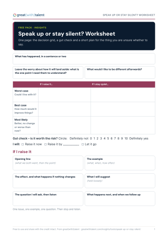
Speak up or stay silent? Worksheet
The grid, the gut check and the plan on one page, for when you would rather think it through with a pen.
Written by great{with}talent from our consultants’ practice in courageous-conversation planning. Related: The trouble with the feedback sandwich. For an independent, confidential route for staff to raise concerns, see SafeSpace.
The clearest thirty minutes in your week.
Book a walk-through with a real person, or start with a pilot or a 30-minute conversation.