RACI without the politics: build one and check it.
A RACI chart is a simple grid of who does what. Its value is not the grid but the arguments it surfaces before they happen in the work.
On this page
Add your actions and people, click each cell to set R, A, C or I, and the checker flags what to look at again, by person and by action. Nothing is stored.
Free download: RACI template and warning signs ↓An illustrative example is loaded so you can see the checks working. Click any cell to cycle through blank, R, A, R+A, C and I. Add or remove actions and people, or clear it and start your own.
R ResponsibleA AccountableC ConsultedI Informed
The checks follow the warning signs below. Thresholds are rules of thumb, not rules.
What the four letters mean
Each cell holds one of four letters, or nothing at all.
| Letter | Means | In practice |
|---|---|---|
| R | Responsible – the doer | Carries out the work. There can be more than one, though one should lead. |
| A | Accountable – the buck stops here | Owns the outcome and has the final yes or no. Exactly one per action, and often also an R. |
| C | Consulted – skin in the game | Asked for their view before the decision is made. Two-way: their input can change the answer. |
| I | Informed – kept in the picture | Told once the decision is made. One-way. |
RACI charts tend to fail in one of two ways. Either one person builds them for everyone else, so nobody feels they agreed to anything, or they are built to avoid an argument, so every awkward cell becomes a C. The method below is designed to have the argument early, in the room, while it is still cheap.
How to build one
List the actions that matter
Specific deliverables and decisions, written as verbs: “approve the new rota rules”, “configure the scheduling system”. Leave out the generic – “attend project meetings”, “keep stakeholders updated” – because they fill the chart and hide the real questions. Eight to fifteen rows is plenty for one initiative.
List everyone involved or affected
Individuals, roles or teams: whoever will do the work, sign it off, have a view on it or live with the result. People affected by an action belong on the chart even if they do none of it.
Start each row with the A
Ask “if this goes wrong, who will be asked why?” That is the A. Then the doers, then whoever must be consulted before the decision, then whoever needs to know after it.
Allow only one A per action
If two people both claim it, or neither will take it, you have found a real disagreement. Settle it now, with the sponsor if necessary. It is far cheaper here than halfway through delivery.
Be sparing with C and I, and leave blanks
Every C adds time to a decision and every I adds to somebody’s inbox. Blanks are fine; many people will have nothing to do with many of the actions.
Build it together, then read it twice
Build the chart with the team, on a shared screen or a wall, in about an hour. Then read down each person’s column and across each action’s row against the warning signs below. Ownership comes from the conversation, not the document.
The warning signs
None of these patterns is automatically wrong. Each is a question to put to the team.
Reading down each person’s column
| If you see | Ask |
|---|---|
| Lots of Rs | Can this person carry the workload, and is the plan leaning on them more than it should? |
| No blanks at all | Do they need to be involved in everything? Often a sign of a bottleneck, or of someone who finds it hard to let go. |
| Only Cs and Is | Why are they on the chart? They may belong in the communication plan rather than the RACI. |
| Several As | Decisions will queue at their desk. Could some of that accountability be delegated? |
| No role at all | Remove them from the chart, or check whether an action that involves them is missing. |
Reading across each action’s row
| If you see | Ask |
|---|---|
| No R | Who is actually doing it? Possibly nobody. |
| Several Rs | Shared doing can mean nobody owns it, and it invites politics. Name a lead. |
| No A | Buck-passing waiting to happen. Every action needs one person the buck stops with. |
| More than one A | Expect confusion and a power struggle. Agree one. |
| Neither R nor A | The work will probably happen ad hoc, if at all. Does it need a simple process? |
| Lots of Cs | Should some of them be Is? Every consultation slows the decision. |
| No Cs or Is | Nobody is being engaged, so expect resistance later. Or the action is too detailed for this chart. |
| Lots of Is | Does everyone need to know, or are people being copied in to be safe? |
Keeping it alive
Put the chart where the team works and go back to it whenever something slips: slippage often traces back to a row with no real A or a person with too many Rs. Revisit it when people join or leave and when the scope changes. And when someone asks “who’s doing this?” in a meeting, the answer should be “check the chart”, not a silence.
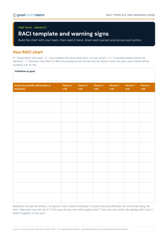
RACI template and warning signs
A blank RACI chart for up to six people and eleven actions, and the warning-signs checklist to read it against.
From great{with}talent’s management toolkit Engaging your people (2014). RACI is a widely used convention for assigning responsibility with no single author. If the team has not yet agreed why it exists and how it will work, start with Starting a new team or project. To see how a team is experienced by the people in it, WinningFormula measures team environment alongside five other drivers of performance.
The clearest thirty minutes in your week.
Send us your last engagement survey and we’ll show you what it’s missing – no charge, no deck, no obligation. Or start with a pilot or a 30-minute conversation.