Active listening for managers: a short, practical guide.
Most managers are promoted for solving problems, so they listen the way problem-solvers do: for the facts, and a gap to offer a fix. That is not the same as making someone feel heard.
On this page
Keep listening for facts, and add listening for meaning: seven moves with words you can use tomorrow, and a two-minute check afterwards on whether it worked.
Free download: Active listening card ↓“Active listening” is an old idea in management terms. Carl Rogers and Richard Farson coined the phrase in 1957, in a paper for managers on how to help people talk through problems. The core of it has not changed: listen for what the other person means, and show them you have understood it, before you move to what you think.
It matters for a manager for a practical reason. In our experience, people bring problems earlier, and say more about them, to someone they know will listen. A manager who jumps to a fix hears the version of the problem that fits the fix.
Four ways managers listen
It helps to know which kind of listening you are doing. All four have a place; the trouble starts when the first two are the only ones you use.
| Way of listening | What is going on | When it is enough |
|---|---|---|
| Waiting to talk | You hear enough to reply. Part of your attention is on what you will say next. | Small talk. Rarely anything that matters to them. |
| Listening for facts | You collect what you need to solve the problem: what, when, who. | A quick operational question with a clear answer. |
| Listening for meaning | You listen for what this means to them, how they feel about it and what they want. | Most one-to-ones, coaching and development conversations. |
| Listening for what isn’t said | You notice pauses, changes of subject, the thing they keep coming back to or avoid. | Difficult conversations, change, anything where people are guarded. |
Seven moves, with words you can use
First, pick your moment. If you can’t give the conversation your attention now, say when you can, and keep to it; half-listening tells the person exactly where they rank. Put the phone away and shut the other tabs. Then use these moves as the conversation needs them.
Leave a gap
When the person stops talking, don’t fill the space straight away. Something important often follows a pause, once they have decided you are not about to take over.
Use their words
When you play something back, keep their vocabulary rather than translating it into yours: “So the handover is the sticking point.” It proves you heard, and it gives them the chance to put you right.
Guess the feeling out loud
“I’m guessing that was maddening. Am I close?” Make it a guess, not a verdict. A wrong guess is still useful: the correction usually tells you more than the guess did.
Ask for an example
Big words such as “always”, “a nightmare” or “no support” carry a lot and say little. “Can you give me an example of when that happened?” gets you to the detail. One question, then listen.
Follow what they return to
Notice the topic they keep circling back to, or the one they skate past. Name it lightly: “That’s the second time the rota has come up. Shall we stay on it?” It is an offer, not an accusation.
Pull it together
Every so often, gather up what you have heard in a sentence or two: “Here’s what I’ve taken from this so far… What would you add?” It checks your understanding and often helps them see their own thinking more clearly.
Ask what they want from you
Before offering anything, ask: “What would help most right now: me just listening, thinking it through together, or doing something about it?” Often the answer is the first, and asking saves both of you a solution nobody wanted.
On calls and video
Remote conversations remove many of the cues you would pick up in a room, so the moves above matter more, not less. Turn your camera on if they have theirs on. Shut the other tabs: people often notice when your eyes drift to email. Say when you are taking notes, so a pause does not read as distraction. Summarise more often than you would face to face.
What gets in the way
A verdict you have already reached
If you have decided someone is a complainer, you will listen for evidence that they are. Notice the label and set it aside for the length of the conversation.
Rehearsing your reply
If you are composing your answer, you are back to waiting to talk. A note of one word, to come back to later, frees your attention.
Fixing too early
The first problem described is often not the real one. Fix it and you may never hear the second.
Discomfort with feelings
Many managers move quickly to practical steps when someone is upset, because the emotion is uncomfortable. In our experience, acknowledging it briefly (“That sounds hard”) lets the conversation move on faster than steering round it.
How to practise
Pick one conversation a day and listen for meaning on purpose. Afterwards, spend two minutes on one question: what did they say mattered most to them? If you cannot answer, you were listening for facts. Over a few weeks, watch for the signs it is working: people say more, they raise problems earlier, and your summaries get the answer “yes, exactly”.
Listening is the core skill under every other conversation a manager has. It sits at the centre of a good one-to-one, a GROW coaching conversation and a tough conversation.
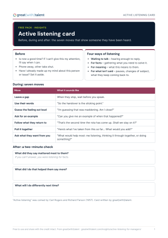
Active listening card
A one-page card: before, during and after, with the seven moves and a two-minute check.
The term “active listening” comes from Carl Rogers and Richard Farson, Active Listening (University of Chicago Industrial Relations Center, 1957). The four ways of listening and the seven moves are written by great{with}talent. When an organisation wants to listen at scale, see WinningFormula.
The clearest thirty minutes in your week.
Send us your last engagement survey and we’ll show you what it’s missing – no charge, no deck, no obligation. Or start with a pilot or a 30-minute conversation.