Before you buy training: a four-step needs analysis.
“My team needs a time-management course.” Requests like this are among the most common a learning team hears, and often the wrong answer to a real problem.
On this page
An hour with the person asking, in four steps, tells you whether training will fix it and what to measure if it does.
Free download: Training needs analysis worksheet and feedback form ↓A request for training is usually a conclusion someone has already reached. Sometimes it is right. Often the real issue is unclear expectations, a process that gets in the way, a manager who never gives feedback, or a target that rewards the wrong thing, and a course will be enjoyed, forgotten and blamed. The four steps below are a structured conversation with whoever is asking. They take about an hour, and they either sharpen the brief or save the budget.
Describe the current state
Get the problem described as results, not as a gap in people. Ask:
- What is the business issue? (“Projects finish late”, not “they can’t manage their time”.)
- Who owns this request, and who has the authority to decide what happens?
- How long has it been a problem, and how widespread is it – how many people, in which teams?
- What is the evidence? Data, complaints and observed behaviour count; impressions are a starting point, not a finding.
- What happens if it is not solved? What is it costing in money, customers, people or risk?
- What has already been tried, and what happened?
If the issue sits with one team or one manager, that is a finding in itself.
Describe the desired state
Ask for three wishes: if this were solved, what would people be doing differently, and what would you see, hear or measure? Push for something observable. “Better communication” becomes “customers get a reply within a day” or “handovers between shifts cover the five things on the checklist”. Then ask what that is worth. The answer becomes your evaluation measure later, and it tells you how much it is sensible to spend.
Find the root cause
There are four broad reasons people do not do what is expected, and only two of them are training’s to fix. For each, ask “how do you know?”
Cause Test question Likely fix Knowledge Do they know what to do, and to what standard? Information, a clear standard, a job aid. Sometimes training. Skill Do they know how to do it? Have they ever done it well? Training, practice, coaching. Attitude or belief If you offered them £1m to do it tomorrow, could they? If yes, it is motivation, confidence or priority. Look at the manager, the consequences and the conversation, not a course. Environment Are expectations clear and communicated? Is the right thing rewarded? Do they have the time, tools and priorities? Fix the system: goals, process, workload, reward, management. The performance problem diagnostic works through the same kind of root-cause questions for one person’s performance.
Choose the intervention, and decide now how you will evaluate it
Weigh timing, the resources available and the level of commitment – above all, who will release people to attend and who will reinforce the learning afterwards. Without a manager who expects and notices the new behaviour, in our experience most training fades within weeks. Then, before you sign anything, decide how you will judge success: the outputs (what was delivered, who attended, what they learned) and the outcomes (what changed in behaviour and results).
Evaluating it: the four levels
Donald Kirkpatrick’s model, first set out in 1959, is still the clearest way to think about whether training worked.
- Level 1, reaction: what participants thought of it.
- Level 2, learning: whether knowledge, skill or confidence changed, tested against the objectives.
- Level 3, behaviour: whether people are doing anything differently back at work.
- Level 4, results: whether the business measure moved. Each level answers a different question; each is harder to measure than the one before, and level 4 is the hardest to attribute to the training.
Most evaluation stops at level 1 for practical reasons. Reaction forms are collected in the room, at no cost, while people are still there. Levels 3 and 4 need a measure that existed before the programme and someone to look at it afterwards, and usually nobody defined either. A needs analysis fixes that: the desired state from step 2 is your level 4 measure, and the behaviours that would produce it are your level 3. Write them down before the programme starts, take a baseline, and diary the follow-up.
For level 3, the simplest method is a conversation six to eight weeks later between the participant and their manager: what have you done differently since, and what difference has it made? For leadership programmes, a before-and-after view from colleagues gives a more independent read.
A better feedback form
The standard happy sheet asks about the venue, the lunch and whether the trainer was engaging. Those things matter a little. A more useful form asks, in this order:
- Use first, because that is what levels 3 and 4 depend on: does the person know what they will do differently, can they see how it applies to their own work, and will they get the chance to try it in the next month?
- Then learning: were they stretched rather than told what they already knew, and do they feel more confident than when they arrived?
- Then design, briefly: was the mix of input, discussion and practice right?
- Three open questions: the one thing they will do differently and when they will start, what might get in the way, and what they would change about the session.
Then diary a follow-up for six to eight weeks later.
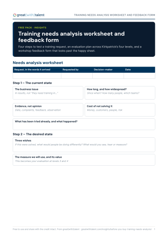
Training needs analysis worksheet and feedback form
The four-step worksheet, an evaluation plan across the four levels, and a one-page workshop feedback form with a follow-up question for six to eight weeks later.
Three traps
- Spending the budget because it exists. A course bought to use up an allocation has no desired state and no measure.
- Training the team for a manager problem. If one team has the issue and its neighbours do not, look at what is different about the team before you look at its members.
- Declaring success on reaction scores. People can enjoy a session that changes nothing, and dislike one that changes a lot.
Drawn from needs-analysis and evaluation methods our consultants have used, rewritten in our words. The four levels are Donald Kirkpatrick’s (1959); the “could they do it if they had to?” test echoes Robert Mager and Peter Pipe’s performance analysis. For a before-and-after measure of behaviour after a leadership programme, see FeedForward 360.
The clearest thirty minutes in your week.
Send us your current 360 framework and we’ll show you how it looks on FeedForward – no charge, no deck, no obligation. Or start with a pilot or a 30-minute conversation.