Your development, your career: getting the most from a development conversation.
This one is written for you, not your manager. A development conversation is one of the few times the organisation sets aside an hour to talk about what you want.
On this page
How to prepare for the conversation, what to do in the room, and how to turn it into a plan you will actually use, with nine questions to start you off.
Free download: Development plan template ↓Three myths worth dropping
| The myth | The reality |
|---|---|
| Development is for people who are struggling. | Development is for people at every level of performance. It is how good becomes very good, and how you get ready for the next thing. |
| Development is the same as performance. | Performance is about your current role. Development is about you – including roles you don’t have yet, and might not have here. |
| Development is the organisation’s job. | The organisation can invest and your manager can help. But it is your development, your career and your plan. Nobody else will care about it as much as you do. |
Who owns what
You own
- Your development plan: writing it, updating it, keeping it live
- Your performance in your current role
- Your career choices
Your manager owns
- Making time for the conversation and the follow-ups
- Understanding you and what you want
- Coaching you, and giving you honest feedback on strengths and gaps
The organisation owns
- Investing in development at every level
- Expecting managers to develop their people
- Making the systems and processes easy
Manage your own expectations
- Be honest with yourself about how you are performing now
- Be realistic about timescales, and about who else wants the same thing
- Still share the dream. A plan without an ambition behind it is just a list
Before the conversation
Think beyond the next twelve months. Consider your development across four areas – skills, knowledge, experience, and behaviour or style – and look at strengths as well as gaps. Ask a few people how they see you, and don’t only ask the ones you get on with: the colleague you find hard work will often tell you the most useful thing. Then spend half an hour with these questions:
- How am I performing in my current role, honestly? What would success look like in a role I am considering?
- What do I hope to be doing at work in a few years: what kind of work, what responsibilities?
- What do I want outside work, and where will I be living?
- What am I passionate about?
- What motivates me, and what drains me?
- What do I love about my current job?
- Which parts of my role am I best at?
- What can I do – from any part of my life – that I don’t use at work?
- What is my reputation here, and how do I know?
Bring notes. You won’t need to read them out, but having thought it through changes the conversation.
During the conversation
You should be doing most of the talking – well over half. It is your conversation. Be as open as you can about your aspirations, even if some of them may eventually take you outside the organisation; a good manager will help you get what you can from here first. Talk about your strengths without apologising: it isn’t boasting, and your manager needs to know what to build on. Mention anything in your wider life that helps them understand you. Ask for their feedback and their view of where you could go. And share whatever thinking you have already done on your plan.
After the conversation: write the plan
Aim to draft your plan within two weeks, while the conversation is fresh. A good plan:
- Says why, what and how for each focus: why it matters to you and the organisation, what the focus is (“presenting to senior audiences”), and how you will develop it.
- Has a blend of learning. The 70:20:10 rule of thumb: most of it on the job (a stretch assignment, leading the next project review, covering for your manager), some from other people (a mentor, a coach, shadowing, asking for feedback after each attempt), and a little formal learning (a course, a qualification, reading).
- Is short. Two or three priorities, added to through the year, beat an exhaustive list you never look at again.
- Leads with strengths as well as gaps.
- Has short and longer-term goals, so you can see progress within weeks, not only years.
Keep it live
Review the plan with your manager regularly – ten minutes over a coffee counts. Record what you did, what you learnt and how you have applied it; that record is what turns activity into development, and it is useful evidence when the next opportunity comes up. Add new areas as you progress. Change the plan when life changes. A plan that was right last spring and hasn’t been touched since isn’t a plan any more.
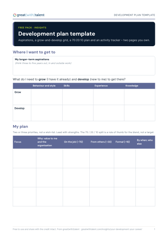
Development plan template
A two-page plan you can fill in: aspirations, a grow-and-develop grid, a 70:20:10 plan and an activity tracker for check-ins.
Drawn from great{with}talent’s development toolkit (the “my development” step-by-step guide and plan template). 70:20:10 is a rule of thumb from Michael Lombardo and Robert Eichinger’s Career Architect Development Planner (1996), drawing on Center for Creative Leadership research. Managers: see the companion Career and development conversations: a manager’s four-step guide. For forward-looking feedback from the people you work with, see FeedForward.
The clearest thirty minutes in your week.
Send us your current 360 framework and we’ll show you how it looks on FeedForward – no charge, no deck, no obligation. Or start with a pilot or a 30-minute conversation.