Setting up a mentoring relationship that works.
Good mentoring relationships rarely happen by accident. In our experience, the ones that last start with a clear purpose, a mentee who drives them and a short, honest agreement on how to work together.
On this page
Be clear what the relationship is for, let the mentee drive it, and agree twelve questions before the real work starts.
Free download: Mentoring agreement ↓A mentor is someone with more experience in an area that matters to you, usually outside your reporting line, who helps you think. They don’t manage your work and they don’t assess you. That independence is the point: it lets you say things you would not say to your manager, and hear things your manager might not say to you.
In our experience, mentoring relationships that start with enthusiasm and then fade rarely fail because of the people. They fail because nobody agreed what the relationship was for, who would drive it, or how they would know it was working.
Mentor, manager, coach, sponsor
| Role | What they bring | Who sets the agenda |
|---|---|---|
| Line manager | Direction, standards, resources and a judgement on performance | Mostly the manager, with the person |
| Coach | Structured questioning to help someone reach a defined goal; expertise in the process rather than the subject | The person being coached, within an agreed brief |
| Mentor | Experience, perspective and contacts, offered in service of the mentee’s own thinking | The mentee |
| Sponsor | Influence: speaking up for someone where decisions are made | Largely the sponsor |
David Clutterbuck describes two broad traditions. In sponsorship mentoring a senior figure advises, guides and opens doors for a protégé. In developmental mentoring the mentor helps the mentee build their own insight and capability, and uses advice sparingly. This guide is about the developmental kind. Sponsorship has its place, but if a mentor is also expected to promote the mentee, say so openly, because it changes what the mentee will feel able to share.
Who owns what
The mentee owns
- What they want from it, and the agenda for each meeting
- Booking the meetings and keeping them
- Doing what they said they would between meetings
- Saying when it isn’t helping
The mentor owns
- Turning up prepared and paying full attention
- Asking more than telling, and offering experience when it helps
- Honesty, including the unwelcome kind
- Keeping confidences, and knowing when to point elsewhere
Five stages, from match to close
Match on purpose
Start from what the mentee wants to learn, not from who is available. A mentor two levels up in another function often works better than the obvious senior name in the same team: less politics, a fresher view. Avoid anyone in the mentee’s reporting line.
Have a chemistry conversation
Twenty or thirty minutes, before anything is agreed. Talk about what the mentee hopes for and what the mentor has to offer. Both should feel free to say no afterwards without having to explain.
Agree how you will work
Use the first proper meeting to work through the twelve questions below and write the answers down. It takes most of an hour and saves several later.
Do the work
The mentee brings one real issue to each meeting. The mentor helps them think it through and, where it helps, shares what they have seen. Each meeting ends with something the mentee will do.
Review, then close well
We suggest a short review after about six weeks and again at the agreed end. A clean close matters: name what has changed, say thank you, and decide whether to carry on, change shape or stop.
Twelve questions to agree
Purpose
- What does the mentee want to be different by the end?
- How will we both know it is working?
- What experience, contacts and perspective does the mentor bring, and what is outside it?
Practicalities
- How often will we meet, for how long, and in person or online?
- Who arranges meetings, and what happens when one has to move?
- How long will we run before deciding whether to carry on?
Ground rules
- What stays between us, and where are the limits (safety, serious wrongdoing)?
- Is anything off limits?
- What does the mentee’s line manager know, and who tells them?
- Can we contact each other between meetings, and how?
Review and ending
- When will we review how it is going, and how will either of us say it isn’t working?
- How will we close it, and what happens afterwards?
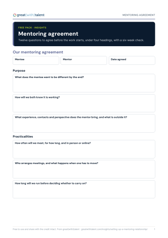
Mentoring agreement
A two-page agreement: the twelve questions under four headings, with space for your answers, and a six-week check.
Questions that help a mentor hold back
Developmental mentoring is more asking than telling. When the urge to advise arrives, try one of these first:
- “What is the decision you are actually facing?”
- “What would you tell a friend in your position?”
- “If this went well, what would you notice first?”
- “Which part of this is yours to decide?”
- “Can I offer something from my own experience? Take it or leave it.”
How it goes wrong
- Pleasant chats, no direction. Meetings that are enjoyable and change nothing. The fix is the mentee bringing one real issue each time.
- Fading after the second month. Diaries fill up and meetings slip. Book the next one before you leave the room.
- The mentor takes over. Solving the problem, making the call, or talking for most of the hour. Useful in the moment; it builds nothing.
- A channel for complaints about the line manager. Listen, then help the mentee work out how to raise it with the manager directly.
- Drifting into counselling. If personal or health issues come up, listen and point to the right support, such as an employee assistance programme or occupational health.
- Looking like favouritism. If the mentor sits on decisions about the mentee, step back from those decisions or change the pairing.
- A confidence repeated. One slip ends the trust. Agree the limits up front, so neither of you is caught out.
When mentoring is part of someone’s wider development, it sits well alongside a development plan they own.
Written by great{with}talent from our consultants’ practice in setting up mentoring programmes. The distinction between developmental and sponsorship mentoring is as described by David Clutterbuck (for example, Everyone Needs a Mentor, 5th edition, 2014). For development that looks forward, see FeedForward.
The clearest thirty minutes in your week.
Send us your current 360 framework and we’ll show you how it looks on FeedForward – no charge, no deck, no obligation. Or start with a pilot or a 30-minute conversation.