Buying coaching: seven questions to answer before you start.
Coaching can be one of the best uses of a development budget, or an expensive way of avoiding a conversation. Seven questions, settled before anyone signs, tell you which it is likely to be.
On this page
- Where coaching tends to fit
- The seven questions
- What should be different, and who would notice?
- Is coaching the right tool?
- Does the person want it?
- Who is paying, and what will they hear?
- Which coach?
- What shape, and for how long?
- How will you know it worked?
- A shape for the programme
- Three things that often go wrong
Check that coaching fits the situation, settle seven questions before anyone signs, give the programme a three-phase shape and judge it against a baseline.
Free download: Coaching agreement and review forms ↓Coaching is often bought in a hurry. A manager mentions that someone “could do with a coach”, HR finds a name, and three months later nobody is sure what the sessions were for or whether they helped. In our experience, the problem is rarely the coach. It is that the questions which decide whether coaching will work were never asked.
This guide is for whoever is commissioning: an HR business partner, a line manager, or someone arranging coaching for themselves. It starts with where coaching tends to fit, then sets out seven questions to settle before the first session, a shape for the programme and a way to judge it.
Where coaching tends to fit
Taking on more
A bigger role, a first senior post, a stretch project.
It fits when: The person is keen and the new demands are clear.
Watch for: Coaching used in place of a proper handover or induction.
Getting unstuck
A capable person whose results or working relationships have stalled.
It fits when: They recognise it and want to change it.
Watch for: A performance problem the manager has not yet raised. Coaching cannot have that conversation for them.
Through a transition
A restructure, a return from leave, a career decision, a move out of the organisation.
It fits when: The change is real and the person wants space to think it through.
Watch for: Unclear expectations about what the organisation wants from the coaching.
Changing how a group leads
A leadership team, or a whole layer of managers, as expectations of leaders change.
It fits when: The organisation is clear about the new expectations and backs them.
Watch for: Individual coaching that pulls against what the organisation actually rewards.
The seven questions
What should be different, and who would notice?
Write the outcome as something people could see. “More strategic” is a hope; “chairs the monthly review so that decisions are made in the room” is an outcome. Name two or three people who would notice the change, because they are also your evidence at the end.
Is coaching the right tool?
Coaching helps capable people think, decide and change how they work. It is the wrong tool for a knowledge gap (training is quicker), for learning the ropes from someone who has done the job (a mentor fits better), for an unclear role (the manager needs to fix it), and for a health or personal crisis (an employee assistance programme, occupational health or clinical support).
Does the person want it?
In our experience, coaching someone who sees it as a punishment seldom works. Ask them directly, and make it possible to say no. If they agree, ask what they would want from it in their own words; it is often different from the sponsor’s version, and both belong in the agreement.
Who is paying, and what will they hear?
Coaching paid for by an organisation has three parties: the person, the coach and a sponsor, usually the line manager or HR. Agree at the start what flows back. One arrangement that works well: the sponsor hears the goals, whether sessions are happening and an overall view of progress, agreed with the person; what is said in the sessions stays there, apart from the usual limits on safety and serious wrongdoing.
Which coach?
Look for relevant experience with people in similar roles, membership of a professional body with a published code of ethics (such as the Association for Coaching, EMCC Global or the International Coaching Federation), and regular supervision of their practice. Then offer the person short introductory calls with two or three coaches and let them choose. Fit matters as much as the CV.
What shape, and for how long?
Decide the length, the rhythm and the budget before you start, and build in a point to stop early if it is not working. The shape we suggest is set out below.
How will you know it worked?
Take a simple baseline before the first session: the person’s own rating against each goal and a few words from the people who would notice. Repeat it at the end and again a few months later. Ask whether the change has lasted, not just whether the sessions were enjoyable.
A shape for the programme
There is no standard length. As a starting point, we would suggest three phases over about six months. Adjust it to the goals, but keep all three: programmes that skip the set-up drift, and programmes that skip the look-back can’t show what they achieved.
| Phase | When | What happens |
|---|---|---|
| Set up | the first two or three weeks | Introductory calls and a choice of coach. A three-way meeting to agree the goals, what will be shared and how success will be judged. A baseline from the person and from the people who would notice. |
| Work | roughly months one to four | Sessions every three to four weeks, with something to try between each. A short three-way check at the midpoint: are these still the right goals? |
| Close and look back | around months five and six | A final session on keeping the change going. A three-way review against the baseline. A brief follow-up about three months later. |
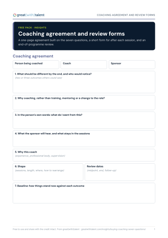
Coaching agreement and review forms
Three pages: an agreement built on the seven questions, a two-minute form for after each session, and an end-of-programme review for the three-way meeting.
Three things that often go wrong
- The sponsor disappears. The manager agrees the goals and is not heard from again. The person then practises new behaviour in a team where nobody notices it. Put the midpoint check and the closing review in the manager’s diary on day one.
- Goals drift without anyone saying so. It is fine for goals to change once the work starts; it often means the coaching has found the real issue. Agree the change openly at the midpoint, so the review measures the right thing.
- Judging it on the sessions. “She really enjoys it” is not evidence of change. Go back to the people who would notice.
If the real need turns out to be a conversation about performance, the performance problem diagnostic will help you prepare for it. For a manager who wants to use coaching skills day to day, see Six ways to intervene when coaching.
Written by great{with}talent from our consultants’ practice in commissioning and delivering coaching. For development feedback that faces forward, see FeedForward.
The clearest thirty minutes in your week.
Send us your current 360 framework and we’ll show you how it looks on FeedForward – no charge, no deck, no obligation. Or start with a pilot or a 30-minute conversation.