Running a 360 feedback conversation: a coach’s and manager’s guide.
The report holds the data. The conversation decides whether anything changes. A good 360 debrief is mostly questions: the person reaches their own conclusions, and the coach makes sure they reach the useful ones.
On this page
- Before the session: five checks
- In the session: six steps
- Open, agree the ground rules and explain the report
- Ask for first reactions, then let them choose where to start
- Explore the patterns and the comments
- Have them name the strengths
- Narrow to two or three actions
- Close
- When the reaction is strong
- If you are also their line manager
- Four pitfalls
Prepare with five checks, let the person lead through six steps and reach their own conclusions, and finish with two or three actions, thanks to every rater and a date to re-measure.
Free download: 360 reflection worksheet ↓This guide is for anyone taking someone through their 360 report: an internal or external coach, an HR business partner, or a line manager. It assumes you have some experience of giving feedback. If you have none, sit in on a debrief before running one; in our experience, a badly handled first conversation can put someone off feedback for a long time.
Before the session: five checks
- Purpose. Why was the 360 commissioned, by the organisation and by the person? What would a good outcome look like for each?
- Raters. Were they told why they were asked, how anonymity works and how the results would be used? If not, expect cautious or bland scores.
- The instrument. Know what the questionnaire measures and how the report is laid out, so you can explain it in a minute.
- Confidentiality. Be sure the person knows who else sees their report, if anyone. Get this wrong and the conversation becomes guarded.
- Your own read. Read the report and note the highs, lows, agreements and differences. Treat these as hypotheses to test with the person, not conclusions to deliver.
In the session: six steps
Open, agree the ground rules and explain the report
Say how long you have, what the session is for, who will see any notes, and that the conclusions are theirs. It is their report. Then, before any data, explain the layout: the rater groups, the scale, where the comments are. Someone who does not understand a chart can spend the session worrying about it.
Ask for first reactions, then let them choose where to start
What pleased them, what surprised them, what it confirmed. Listen more than you speak. This tells you where their attention is and how they are feeling.
Then ask where they would like to begin. If they have no preference, the written comments are often a good place: they give a sense of how people feel before you get into the numbers.
Explore the patterns and the comments
Highs and lows; where rater groups agree; where they differ; the gap between self-ratings and others’. If the report includes importance ratings, compare the person’s with their manager’s, because a difference there is a conversation about priorities. Ask what might explain each pattern before offering your own view.
Read the comments for themes, and steer away from guessing who wrote what. Where a comment suggests a change without saying why, explore with the person what the benefit might be.
Have them name the strengths
Ask them to say out loud the positive messages they have heard. People under scrutiny often skip straight past them, and strengths are a good foundation for the development plan.
Narrow to two or three actions
Generate plenty of possible actions, then help them commit to two or three at most, each with a benefit and a first step. In our experience a short list gets done and a long one does not. Choosing consciously to change nothing in an area is also a legitimate outcome.
Close
Ask them to summarise. Remind them to thank everyone who was invited, not only those they think responded. If they want to explore a point with peers or direct reports, plan that conversation together so nobody feels exposed. Agree the follow-up: a coaching or check-in session in a few weeks, and a re-measure. We suggest around 9 to 12 months for most development areas, with support in between.
Questions to have ready, in the order they usually come up:
Opening
- What is your overall reaction?
- What has pleased you most?
- What has surprised you?
- What has it confirmed for you?
- Where would you like to start?
Exploring
- What do you think explains the difference between these two groups?
- What might people be seeing that leads them to rate this lower than you do?
- What would you say are the main themes?
Committing
- Which strengths have you heard today?
- Which two or three areas matter most for what you need to deliver?
- What would be the benefit of getting better at this?
- What will you do first?
- By when?
When the reaction is strong
- Defensive (“they don’t see what I deal with”): acknowledge it, then ask what might lead people to see it that way. You are not asking them to agree, only to understand.
- Dismissive (“it’s a popularity contest”): go to the most specific comment and ask what is behind it.
- Upset: slow down, stop exploring, and acknowledge it plainly. It is fine to pause and meet again; we suggest within a week, while it is fresh. Do not end the session on the hardest message.
If you are also their line manager
You hold two roles, and you were probably one of the raters. Be explicit about which hat you are wearing. Never ask who said what, and do not speculate about it. Let the person decide what they share beyond what the organisation agreed at the start. And keep the conversation separate from pay or performance ratings unless that use was declared before anyone gave feedback; a 360 that turns out to have been an appraisal is a quick way to lose raters’ trust.
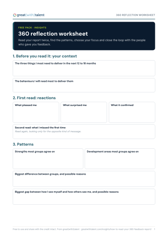
360 reflection worksheet
The reflection worksheet the person can complete before or after your session: context, reactions, patterns, focus and closing the loop.
Four pitfalls
- Interpreting for them. Your reading may be right, but a conclusion they reach themselves is the one they act on.
- Debating the scores. A rating is an account of how someone experiences the person, not a fact to be argued.
- Defending the raters. You don’t know what they meant either; stay with the themes.
- Rushing to action. If the person has not accepted the message, any actions will be for show.
The person can use How to read and act on your 360 feedback report to prepare, and Turning 360 feedback into goals afterwards. Before launching a programme, see Introducing 360 feedback: what to decide first.
Drawn from great{with}talent’s A coach’s guide to using 360 (2013), rewritten for any 360 instrument. For a 360 built around forward-looking suggestions, see FeedForward.
The clearest thirty minutes in your week.
Send us your current 360 framework and we’ll show you how it looks on FeedForward – no charge, no deck, no obligation. Or start with a pilot or a 30-minute conversation.