Turning 360 feedback into goals.
A 360 report tells you how you are seen. It does not tell you what to do on Monday, and that step is where much of the value is lost.
On this page
Goals get lost when they are too many, too vague or about the scores. Choose two or three themes, write each as a behaviour others will notice, plan how you will learn it, and ask for suggestions as you go.
Free download: Goal-setting worksheet ↓Start from what you need to deliver
Before you choose anything from the report, write down the three things you most need to achieve in the next year or so. The best development goals are the ones that help with those. A theme that matters to your raters but not to your role can wait.
Choose two or three themes, including a strength
Pick the themes that most groups agree on and that bear on what you need to deliver. Make one of them a strength to use more widely: if people value how you run client meetings, that is a skill you could bring to internal ones.
Write each one as a behaviour
“Be more inclusive” is a theme, not a goal. Ask: what exactly would I do differently, in which situations, that other people would notice? A behaviour goal names the action and the moment. It is the only kind your raters can see changing.
Add the why and the outcome
For each behaviour, write why it matters (the impact on your team, your customers or your results) and what outcome you expect, with a date. The why keeps you going when the new behaviour feels awkward.
Plan how you will learn it
Use the 70:20:10 rule of thumb as a guide to the blend: most learning on the job (a stretch, a new responsibility, deliberate practice in real meetings), some from other people (a mentor, a coach, someone who does it well), and a little formal learning (a course, reading). In our experience a goal whose only action is “attend a course” rarely changes behaviour.
Plan for the old habit
Old habits return under pressure. Decide in advance what you will do when they do: “If I notice I have decided something for the team without asking, then I will say so at the next team meeting and invite views.” Research on if–then plans suggests they help more than resolve alone.
Tell people, then check progress
Tell your raters, or at least your team and your manager, what you are working on. Every month or so, ask three or four of them one forward-looking question: “What is one thing I could do better on this over the next month?” We suggest a fuller check-in with your manager or coach after about two months, and a re-measure, through a short pulse or another 360, at around 9 to 12 months.
Theme from the report: comments from direct reports say decisions affecting the team are made without them.
Behaviour goal: before deciding anything that changes how the team works, I will ask for views at the Monday meeting, and tell the team what I decided and why by the end of that week.
Why: the team carries out these decisions; involving them should mean fewer surprises and better decisions.
How: practise at every Monday meeting (on the job); ask a peer who does this well how she runs it (from others); read one short guide on facilitating decisions (formal).
If–then: if I catch myself announcing a decision I haven’t discussed, then I will say so and open it up for comment.
Check: after a month, ask three team members: “What is one thing I could do to involve you better?”
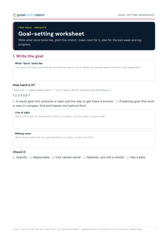
Goal-setting worksheet
The goal-setting worksheet: what done looks like, the stretch, making room, if-then plans and a progress log.
Four pitfalls
- Goals about scores. “Move my communication rating from 3 to 4” puts the goal in other people’s hands. Aim at the behaviour; the score follows if the behaviour changes.
- Too many goals. Two or three, done properly, beat eight attempted.
- Only fixing weaknesses. A plan with no strength in it is demoralising to carry around.
- Private goals. If nobody knows what you are working on, nobody can notice the change or tell you how it is going.
Before setting goals, How to read and act on your 360 feedback report helps you find the themes. For goal setting in general, see How to set goals people actually keep, whose worksheet works well for 360 goals too.
Drawn from great{with}talent’s 360 workbook Making the most of your 360 (2021) and development-planning tools (2013–2015). 70:20:10 is a rule of thumb from Michael Lombardo and Robert Eichinger’s Career Architect Development Planner (1996), drawing on Center for Creative Leadership research. If–then planning: Peter Gollwitzer, “Implementation intentions”, American Psychologist 54(7), 1999. Asking for forward-looking suggestions follows Marshall Goldsmith’s feedforward; see Stop feeding back, start feeding forward and FeedForward.
The clearest thirty minutes in your week.
Send us your current 360 framework and we’ll show you how it looks on FeedForward – no charge, no deck, no obligation. Or start with a pilot or a 30-minute conversation.