How to set goals people actually keep.
In our experience, most goals are abandoned not because they were wrong, but because they were one of twelve, nobody looked at them again until the review, and the first busy week pushed them aside.
On this page
Set fewer goals, write down what done looks like, make room for them, plan for the bad week with if–then plans, and look at progress in every one-to-one.
Free download: Goal-setting worksheet ↓What the research says, briefly
Goal setting has been studied extensively in work psychology, and the main findings are practical. Edwin Locke and Gary Latham, summarising decades of their own and others’ studies in 2002, reported that specific, difficult goals consistently led to higher performance than urging people to “do their best”. Three conditions matter:
- People need feedback on their progress against the goal.
- They need to be committed to it, which matters most when the goal is hard.
- For complex or unfamiliar work, a goal about learning (find three ways to do this, master this process) can work better than a goal about the result, because on a complex task a hard performance target can get in the way of finding a good strategy.
The second useful finding is about follow-through. Peter Gollwitzer’s work on “implementation intentions” shows that people are more likely to act on a goal when they decide in advance exactly what they will do in a specific situation: if this happens, then I will do that. A goal says where you want to get to; an if–then plan deals with the moment it gets difficult.
Six things that make a goal stick
Write down what done looks like
Describe the finished state clearly enough that two people would agree whether it has happened: the result, the date, and how you will both be able to see it. “Improve customer service” fails that test. “Clear the backlog of unanswered complaints by the end of May” passes. If you cannot write it this way yet, the first goal may be to find out what done should look like.
Pitch it high enough to matter
An easy goal gets done and changes nothing; an impossible one gets quietly dropped. Aim for a stretch the person still believes they can reach. Then ask what kind of goal it is. If the work is familiar, set the result. If it is new or complex, set a learning goal first, such as working out and trying three approaches, and set the result once the method is clear.
Show the line of sight
Explain what the team and the organisation are trying to achieve this year, and talk through how this goal helps. Commitment is easier to build when people can see why a goal matters. It also helps to write the wording together rather than handing it over.
Make room for it
A new goal competes with everything already on the list. Agree what moves down, gets handed on or stops, so the goal has time. Keep the overall number small: we suggest a handful at most, three to five, because in our experience, past that, people choose their own priorities, and they may not be yours.
Plan for the bad week
Ask what is most likely to knock the goal off course, and turn each answer into an if–then plan: “If the weekly report starts to slip, then I will block Thursday morning for it.” Two or three of these, written down, do more than a general promise to try hard.
Make progress visible
Agree how you will both see whether things are on track long before the deadline: a number, a milestone, something someone else will notice. Look at it in your regular one-to-ones rather than saving it for the annual review, and change the goal if the situation changes. We suggest checking more often, even weekly, when the task is new or the person is finding it hard, and less often as confidence grows.
Use SMART as a check, not a starting point
SMART comes from George Doran’s 1981 article in Management Review, where the letters stood for specific, measurable, assignable (one named owner), realistic and time-related. Many later versions swap in “achievable” or “agreed”. It is a good test of a goal once written. It is a poor way to choose one: a goal can pass every letter and still be the wrong goal.
Done looks like: by the end of June, most customer calls to my team are resolved on the first contact, measured from the call log against an agreed target.
Stretch and type: a stretch, and new to the team, so the first six weeks are a learning goal: test two ways of sharing answers to common questions and keep the one that works.
Line of sight: the organisation wants fewer customers chasing us; repeat calls are the biggest source of chasing in our area.
Room: the daily status email stops, replaced by a ten-minute Monday stand-up.
If–then: if a fortnight’s call reviews slip, then I will book both into the following Monday before anything else.
Visible progress: the first-contact figure reviewed in each fortnightly one-to-one.
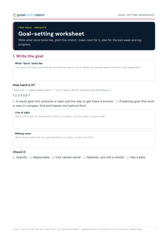
Goal-setting worksheet
Two pages: what done looks like, how hard it is, line of sight, making room, a SMART check, if-then plans and a progress log.
Five pitfalls
- Too many goals. Twelve goals means none of them is a priority.
- Activities dressed as goals. “Attend the course” is a task; what will be different afterwards is the goal.
- Set and forget. A goal nobody looks at for six months has stopped being a goal.
- Goals only the manager understands. If the person cannot explain their goal in a sentence, it is not theirs yet.
- Stretch without support. In our experience a hard goal with no help, no time and no feedback produces anxiety rather than performance.
If the goals are coming out of a 360 report, see Turning 360 feedback into goals. To coach someone towards their own goal, the GROW questions start at the same place.
Written by great{with}talent. Research: Edwin A. Locke and Gary P. Latham, “Building a practically useful theory of goal setting and task motivation: a 35-year odyssey”, American Psychologist 57(9), 2002; Peter M. Gollwitzer, “Implementation intentions: strong effects of simple plans”, American Psychologist 54(7), 1999; George T. Doran, “There’s a S.M.A.R.T. way to write management’s goals and objectives”, Management Review 70(11), 1981. For forward-looking feedback on progress, see FeedForward.
The clearest thirty minutes in your week.
Send us your current 360 framework and we’ll show you how it looks on FeedForward – no charge, no deck, no obligation. Or start with a pilot or a 30-minute conversation.