Your first 90 days as a new manager.
Whether you were promoted from inside the team or hired in from outside, your first three months as a manager set the pattern for everything after.
On this page
Agree six things with your own manager, then listen, set clarity and deliver, in that order.
Free download: 30-60-90 day plan for a new manager ↓The real change
Your team is deciding what kind of manager you are, and you are learning a job that is mostly not the one you were good at. People are often made managers because they were good at the job. The trouble is that the job has changed. Your days fill with other people’s questions, your output is the team’s output, and the skills that got you promoted – expertise, speed, doing it yourself – can now get in the way. Becoming a manager is less a new set of tasks than a new way of seeing your work, and it takes time. A plan for the first ninety days gives that change some structure.
Before you start: agree six things with your own manager
Ask for an hour with the person you will report to, and leave with answers to these:
- What will good look like at ninety days? Two or three outcomes, not a list of activities.
- And at twelve months?
- Which decisions are mine? Budget, hiring, priorities, how the team works.
- What am I inheriting? Performance issues, open vacancies, a project in trouble, a team that has had three managers in two years.
- How will my own performance be measured?
- How do you want to be kept informed? How often, in what form, and what you want to hear about straight away.
Three phases
Each phase has one job. The dates are a guide; move on when the work of the phase is done.
Days 1–30: listen and learn
We suggest a one-to-one with every member of the team in the first two weeks. Ask the same five questions of each, so you can compare what you hear:
- What do you most enjoy about your work?
- What gets in the way of doing it well?
- What should I keep the same?
- What would you change if you were me?
- How do you like to be managed?
Then meet the people your team depends on, and who depend on it. Read whatever data exists: performance, workload, sickness absence, turnover, engagement or new-starter survey results. Change very little. Where something is plainly broken and easy to fix, fix it – an early, visible improvement tells people you were listening – but save the bigger changes until you understand why things are as they are.
Days 31–60: set clarity and rhythm
Now agree with each person what they are responsible for, what good looks like, and how their performance will be measured and reviewed. Write it down. Set the rhythm you will keep: one-to-ones (we suggest weekly or fortnightly to begin with), a regular team meeting with a clear purpose, and a habit of short, specific feedback in between. Agree a development plan with each person – two or three things they want to get better at and how. This is often the missing piece: in our new-starter data, only 66% of people a few months into a new job say they have an agreed development plan, and 77% understand how their performance is measured.
If there is a performance problem, start the conversation now rather than hoping it resolves itself. A clear, early, private conversation is kinder than a late one. Four steps to an effective tough conversation sets out how.
Days 61–90: deliver and review
Pick one or two improvements the team agrees matter, and deliver them. Visible progress on something people raised in the first month builds more trust than any number of plans. Ask your team for feedback on how you are managing: what to keep doing, what to change. Then sit down with your own manager, review the outcomes you agreed before you started, and set priorities for the next ninety days.
If you have been promoted from within the team
Managing former peers is its own challenge. Talk about the change openly, early, with each person: the relationship has changed, and pretending otherwise helps nobody. Be visibly fair. Close colleagues will expect more, and everyone else will watch whether they get it. Expect someone to be disappointed, especially if they also applied for the role; a direct conversation about what they want next is better than avoidance. And resist the pull to keep doing your old job. Hand the work over and coach whoever takes it on.
If you have been hired in from outside
You have the advantage of fresh eyes and the disadvantage of not knowing the history. The listening phase matters even more. Find out what the previous manager did well, so you do not dismantle it by accident, and learn the unwritten rules: who makes decisions, how work really gets done, which processes people work around and why.
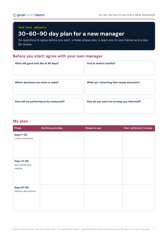
30-60-90 day plan for a new manager
Six questions to agree before you start, a three-phase plan, a one-to-one tracker for your team and a day-90 review.
Pitfalls
- Doing the work yourself. It feels productive and it is quicker, but it stops the team growing and leaves you no time to manage.
- Changing too much, too fast. Changes made without understanding the reasons can end up being reversed, at a cost to your credibility.
- Avoiding the hard conversation. Problems you inherit become problems you own at around the point people decide you are not going to deal with them.
- Trying to be liked. Aim to be fair and clear; respect follows.
- Forgetting your own manager. Keep them informed the way they asked, especially about problems.
- Neglecting your own development. Ask for training, find someone who has done the job well to talk to – a mentor is ideal – and ask for feedback from your team.
After ninety days
Keep the rhythm. The one-to-ones, the clear goals, the development plans and the regular feedback are not a start-up routine; they are the job. For the development conversations, a development conversation that lands is a good place to start. When a new person joins your team, the early-leaver risk check applies the same thinking to their first months. And once you have been in post for a while – we suggest six months or so – a 360 review tells you how your team sees you: see what to decide before introducing 360 feedback.
Drawn from great{with}talent’s management development programmes (the role of the manager, performance clarity, development conversations and team working), 2014–2016. The ninety-day frame for leadership transitions was popularised by Michael Watkins, The First 90 Days (Harvard Business School Press, 2003), which also stresses agreeing expectations early with your own manager and securing early wins; the idea of becoming a manager as a change of identity comes from Linda A. Hill, Becoming a Manager (Harvard Business School Press, 1992). The plan here is our own. For forward-looking feedback on how a new manager is doing, see FeedForward.
The clearest thirty minutes in your week.
Send us your current 360 framework and we’ll show you how it looks on FeedForward – no charge, no deck, no obligation. Or start with a pilot or a 30-minute conversation.